
by Felicien | May 21, 2019 | Education
It’s always been important for the C-suite to understand the cost benefits and value associated with technology projects, but today’s complex infrastructure needs are requiring greater levels of input from financial executives, in particular. Technology spends are increasing dramatically, and there’s a need to balance the shorter-term benefits of specific tactics with the long-term strategies that will help move the organization forward. The days of technology teams making do with the funding that they are allowed are over, as technology becomes more tightly intertwined with business strategy. It is crucial that the big dollars invested in technology and innovation are tied to true business value in a way that can be communicated throughout the organization — making the CFO an integral part of the decision-making when it comes to determining the IT spend.
Funding Sustainable Growth
Technology is advancing at an unbelievable rate, with new software applications and methods of reaching customers coming at breakneck speed. Making several poor decisions around technology can create a miasma of problems that can take years to resolve, but that risk is mitigated when financial leaders work closely with technology teams to ensure that there are adequate measures and milestones in place. CFOs must ensure that the organization has the funds available to budget for items that are critical for continued business operations that support corporate strategy and sustainable growth initiatives. This has to be balanced with the additional risk that can be assumed by waiting for “something better” (an application, a way of controlling data or reduced legislation) to come along. According to Gartner, worldwide IT spending is set to reach $3.8 trillion this year, with ongoing increases in spending attributed to IoT, shifting on-premise computing to the cloud, software applications and maintenance fees. With this shift comes a fundamental change in the way technology dollars are budgeted: from capital expenditures to a SaaS model that is billed as an operating expense.
Aligning Technology Spend with Strategic Initiatives
Starting with the strategic initiatives of the business and slotting in technology where needed may be the way CIOs and CTOs are familiar with budgeting, but the new paradigm requires additional work. The risk potential of having business systems vulnerable to a cyberattack is an ongoing concern and one that can require a significant amount of spending in any given year. Data silos are being broken down and consolidated as older legacy systems reach their sunset years. This tension between supporting an often-aging infrastructure and providing a stable base for the future creates a need for creative budgeting throughout the organization. Having the CFO work with technology executives can help bring greater visibility to the IT needs of the organization and how they align with specific strategic initiatives.
Constantly Examining Technology ROI
Part of the budgeting process involves being intentional about determining business ROI for the various technology initiatives and being unafraid to boldly cut or fund projects based on the changing needs of the business. New threats occur on a regular basis — as well as new opportunities to seize dominance in a particular market. Having the flexibility to pivot and create revenue may require a continual review of the various projects as well as a fundamentally different approach to what have traditionally been multi-year IT projects. Vigorously defending projects that no longer provide business ROI can put a major drain on limited organizational resources, especially in light of changing features and functionality for even the most stable business platforms.
Now more than ever, CFOs must have a solid understanding of the business value that IT projects plan to deliver and a solid review of milestones. This shared responsibility with CIOs and CTOs creates not only a greater accord in financial decisions but also a deeper understanding of the value that various projects have for the entire business.

by Felicien | May 21, 2019 | Education
The role of the CMO has been evolving at a rapid pace in recent years due to the constant addition of new marketing technologies or martech. You only have to compare the tech budgets of marketing departments today to those five years ago to see a drastic increase in spending.
Companies know that they need to embrace and leverage the right martech to remain competitive, and they are willing to invest substantial sums to do so. That leaves companies and key decision makers with a challenging question: What kind of role should the CMO play in tech decisions? The answer depends on the industry vertical, but there is an overall trend that is worth paying attention to. With each passing year, CMOs are becoming more and more involved in tech decisions.
How Involved Should CMOs Be in Tech Decisions?
To understand the answer to this question, we need to look at a few different factors. These include:
The Changing Role of CMOs
The traditional CMO role was already filled with important decisions. Chief Marketing Officers have always been responsible for things like brand management, communications, campaigns and advertising. But today, with the rise of data-driven decisions—which offer more predictability and accuracy than opinions ever could—the role of the CMO has had to evolve to encompass more and more tech.
Consider the options for understanding the customer experience available to marketing teams today:
Artificial Intelligence (AI)
Big Data
Marketing Automation
Internet of Things (IoT)
And more…
Incorporating these tools into the company’s marketing mission requires a whole new skillset that includes customer service, data analysis, user experience (UX) and more. Of course, not all CMOs need to be experts in any one of these particular areas, but they do need to know how to manage and organize professionals who do understand these areas to fully realize the potential of their marketing efforts.
The Importance of Company Objectives
If you have recently found yourself feeling overwhelmed with the number of tech tools available, you have some idea of what it feels like to be a CMO in today’s tech-heavy environment. A visit to your favorite app store will give you the opportunity to pick from sometimes thousands of apps to accomplish the same goal, whatever that goal may be. And while the martech options available to CMOs are perhaps less numerous, they are also being pushed by sales people on a daily basis—so CMOs are being constantly bombarded with new “solutions” that are touted as the newest answer to common problems. Even more confusing, there are plenty of martech offerings that are more like solutions looking for problems than the other way around.
One of the key ways that CMOs can avoid overwhelm when it comes to martech is to always keep company objectives at the forefront of their minds. The company objectives can vary by organization, but most marketing organizations are focused on things like Market Presence, Revenue Growth and Efficiency. These goals can be more easily achieved using the right martech, but not all tech tools are going to offer significant benefit in the seeking of such goals.
Company objectives offer a guiding light in the complex world of martech. CMOs, above all others in the marketing organization, need to remain aware of company objectives and ensure that the tech budget is utilized as efficiently as possible—on technologies that will achieve measurable progress towards the achievement of the goals of the company.
CMOs Can Use Data to Drive Tech Decisions—Especially if They Ask Questions
One of the best ways CMOs can target the tech that is right for their organization is to utilize data in the decision making process. And that does not mean the CMO needs to be an expert in data analysis, either. They just need a team that can help them understand the data that they are looking at. Subjective decisions are not necessary—at least not in most cases—with the use of the right data.
The secret to utilizing data is to ask questions, as many questions as necessary to gain an understanding of what you are looking at. Over time, a CMO can come to understand quite complex concepts as he or she repeatedly comes into contact with them. But as with any new information, the fastest way to gain an understanding is to ask questions. It can be difficult at first for someone in a position of authority to admit that they do not know something right off the bat, but eventually asking questions becomes easy.
While it may not be apparent initially, employees will feel respect for the leader that is willing to admit a lack of understanding and ask for help. After all, the employee gains a sense of value when they can help higher-ups and the company as a whole with their knowledge.
CMOs Should Be an Integral Part of Tech Decisions
Ultimately, CMOs should strive to be an integral part of tech decisions in the company. They should work with their team, as well as with other key decision makers like the CIO and CTO, to guide the company in the right direction.
by Felicien | May 21, 2019 | Education
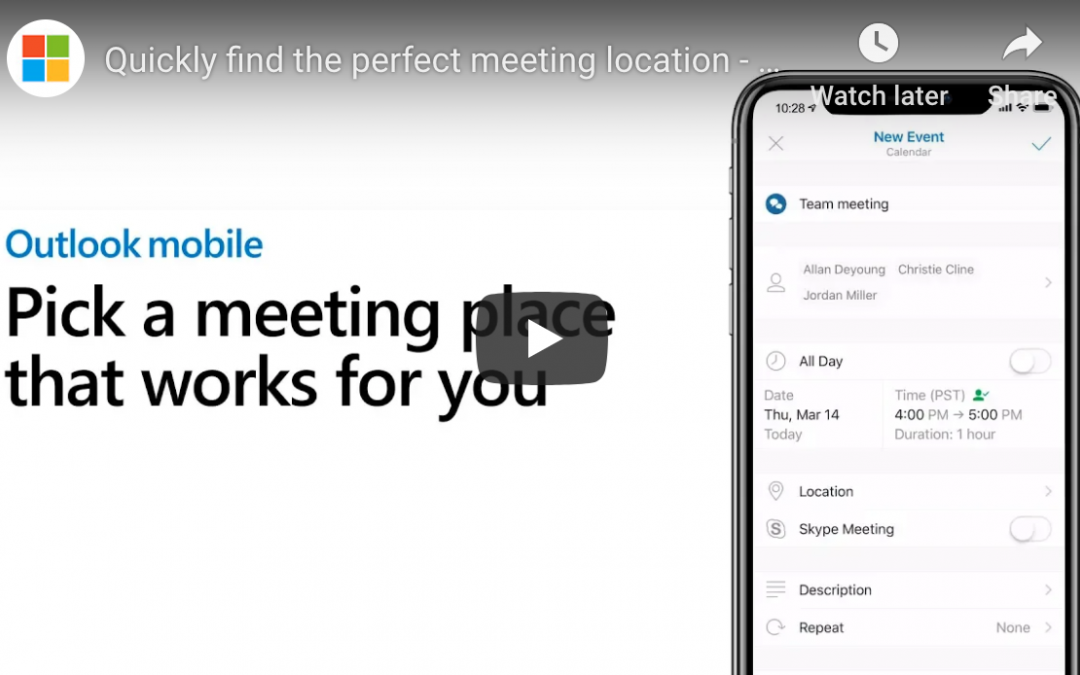
Microsoft’s Office suite makes it easy to schedule meetings, reserving the right room and inviting all the right people. Many people think they can only use these powerful features from their office computer, because Exchange calendar integration in iOS doesn’t support these features. In reality, mobile users can still access these powerful scheduling features using Outlook Mobile. Here’s how.
Step 1: Create a New Event
Open your Outlook Mobile and create a new event. To do this, tap on the calendar tab along the bottom of the app. Next, press the big plus sign in the lower right corner. (As always, locations can change over time and depending on device. You’re likely to find a calendar page and a plus sign somewhere, though—use them.)
Step 2: Name Event, Add Attendees, and Set Date and Time
Choose a name for your meeting in the first field, and add all the people you want to attend the meeting in the second one. For the latter, just start typing names. Outlook Mobile will pull up relevant contact information. Click on the contacts you want to include.
Note: Depending on your configuration settings, Outlook Mobile may offer you multiple options for some contacts. If you have a personal and a work version of a contact, for example, be sure you choose the right one. Do the same if you have a single contact with multiple email addresses associated.
Before moving to step 3, check that the date and time information is set correctly. You can change this later, but setting it up now allows the magic below to work properly.
Step 3: Click Location
Next, tap the “location” field a little bit lower on the screen. This is where the magic happens. Outlook Mobile will intelligently suggest connected meeting rooms that you use frequently and that are free for your selected time. It will also suggest places nearby, which is useful if you’re calling an off-site meeting. Outlook Mobile learns from you, too: the more you use it, the smarter its suggestions become.
If you don’t see a suitable location listed, you can search for a better one. This can be an on-site meeting room or any mappable location.
If you and your meeting attendees have “Time to Leave” enabled in settings, Outlook Mobile will even notify you a few minutes before you need to leave your current location to get to the meeting on time. One-touch directions are available directly in the calendar event, too.
Wrap Up
This is just one of many powerful yet overlooked features in Outlook Mobile. To learn more or for help with other IT questions, contact us today.

by Felicien | May 20, 2019 | Education
Cyber attackers are highly motivated to obtain or corrupt your company’s data. But whether their motivation is to steal your funds outright, hold your data for ransom, practice espionage, or simply disrupt your business, most hackers cannot access your network without an “in.”
In other words, they require a login, personal access codes, or network access through malware to initialize their breach. Unfortunately, a recent report released by Verizon has concluded that 93% of the time, a cyber attacker’s “in” comes to them in the form of a social engineering attack on your employees.
The only way to prevent such breaches in your security is with proper cybersecurity training.
What is a social engineering attack?
Social engineering attacks are frankly less high-tech than traditional cyber attacks by highly knowledgeable tech criminals. In other words, they don’t require the extensive knowledge and tools needed to directly hack a highly protected computer system out of nowhere.
Social engineering attacks are more like street scams — only they’re usually done online or sometimes, over the phone. These scams use human psychology to fool individuals into willingly giving up sensitive information. In the case of your business, the targets are your employees.
There are several types of these attacks, including “phishing” and “pretexting,” which are quite similar and often go hand-in-hand. Phishing emails, however, remain the most common type of social engineering scam.
What are phishing emails?
In short, a phishing scam might be an email sent to the employees of your company that looks legitimate. It might (appear to) be from the employee’s bank, for example. It might request that your employee “click here” and login to (what looks like) the bank website so that the bank can “update your information” or “confirm your identity.”
A phishing email might also promise something to the recipient: “Here’s your free 50% off coupon! Click here!” or use a so-called emergency to illicit fear: “Someone has hacked your account. Click here to get it back.”
If your employee does indeed click on the malicious link of a phishing email, they will likely be taken to a blank or uninteresting page. In the meantime, however, the link click will have initiated the installation of malware onto the employee’s computer. This malware then enables the hacker to obtain sensitive information or disrupt or damage your company’s data.
How can company’s prevent phishing scams?
The reputational implications of any type of security breach — even one that doesn’t actually corrupt or steal your data or funds — can be enormous. Of course, it goes without saying that if you are caught in the crosshairs of a data ransom or cyber theft, the financial implications will be equally devastating.
As we’ve learned from the Verizon report, most security breaches are linked with phishing. Therefore, cybersecurity training for your employees is the best preventive solution you have for stopping security breaches before they start.
Employee training is not expensive, yet it is highly effective. Your employees should learn the following throughout their ongoing training:
How to identify a range of phishing and pretexting scams
How to proceed should they find an email, phone call, or social request suspicious
Your company’s strict policies and procedures for communication (for example, “We would never send emails requesting personal information from our employees as this would only be done in person.”)
Notice of increased risks for phishing scams around the holidays
Notice of the most recent and common scams currently trending
Cybersecurity training should be frequent and come at regular intervals throughout the year as attack strategies often come randomly in spurts and habitually change tactics.
While cybersecurity training is your best line of defense when it comes to phishing and security breaches, it’s also important to hire a reputable IT managed service provider (MSP) to handle your network and security. Your MSP should have experience and broad skill in protecting their clients from network breaches. Contact qualified MSPs in your area today to learn more about protecting your business from cyber attacks.

by Felicien | May 20, 2019 | Education
Moving from hardware solutions to software solutions isn’t a new concept for technology professionals, but network infrastructure has traditionally been a hardware-focused world even as applications move to the cloud. With the introduction of SD-WAN, or Software-Defined Wide Area Networks, IT professionals find themselves needing to retool their understanding of flexible networks and security. The MPLS (Multiprotocol Label Switching) has been in use for decades and is an extremely reliable — yet pricey — option for connectivity. Today’s SD-WAN provides the modern organization with the flexibility, scalability, security and efficiency needed to stay competitive in a fast-changing world.
The Basics of SD-WAN
At its most basic, you can think of SD-WAN as a way to tie together a variety of disparate networks as it is equally efficient with internal as well as external internet and even cloud-based applications. Instead of a more rigid WAN network, SD-WAN allows you to configure your network quickly from a centralized location, reducing the potential of human error that can bring your network to its knees and productivity to a screeching halt. Since all variables are driven by software that you configure, this structure can be quickly scaled and new remote locations added without requiring an intense investment in time and physical hardware or redesign.
How Do You Manage a Software-Defined Network?
A key value that you gain when you shift to an SD-WAN is the ability to make shifts locally as well as globally from a centralized dashboard. This makes changes swifter, but also helps protect your network by ensuring that universal security standards are applied at all locations equally. Using an SD-WAN configuration gives you the added benefit of consolidated troubleshooting and error reporting so you can quickly identify any trouble spots or network hotspots and shift resources as needed to add speed and efficiency to your network — something that users are sure to appreciate, even if they never realize it is happening.
What Are the Business Benefits of SD-WAN?
Upgrading your network from a more restrictive model to SD-WAN has a variety of benefits for your organization. While some of these gains are realized upfront, others will continue to add value to your organization over time.
The cost of connectivity using an SD-WAN is less expensive than traditional MPLS, an especially important point when you consider the bandwidth-heavy applications that business users require.
While there is a high level of expertise required for upfront configuration of a software-defined network, ongoing changes are less intensive and can potentially save you consulting fees in the future.
Your business users will appreciate that network availability is high because there is no need to take the network down to make configuration changes or upgrades.
Your technology team is able to define networking rules in the language of business — SLAs, security restraints, apps and users — making the network easier to understand and maintain in the future.
With Gartner noting that nearly 25% of businesses will utilize SD-WAN in 2019, there is a growing body of knowledge within the IT community that makes it easier to find resources to support your network infrastructure. The SD-WAN market is expected to grow to $1.3 billion by 2020.
Cloud-based applications continue to emerge in all sectors of business, and it can be challenging to protect these applications without a consolidated hub of security rules. SD-WAN allows everything from SaaS to traditional connections to be covered under the same business rules.
Branches and remote workers will appreciate having access to the same high quality of connection that they enjoy at the office, instead of having to deal with restrictive security procedures and application latency.
Instead of relying on the hardware to make decisions about connections speed and connections as with MPLS, SD-WAN makes agile decisions about the best way to connect users and the data or applications that they need to access.
What Type of Business Benefits from SD-WAN?
While there are many benefits of SD-WAN, there is one downside that can be a deal-breaker for certain organizations. Software-Defined WAN does provide extremely reliable uptime, but there can be more packet loss than you would see with a hardware-based network. In this case, you may want to consider a hybrid infrastructure that lets you gain the benefits of SD-WAN for the majority of your applications yet maintains any heavy applications that simply cannot abide packet loss on a more traditional MPLS. The majority of organizations are looking for ways to reduce their cost of connectivity and have very heavy use of their internet or intranet connections — making SD-WAN ideal. Businesses that are growing quickly or expanding into new regions are also likely to see gains from making the switch.
Many organizations are seeing that shifting to an SD-WAN model may help them future-proof their business by creating a flexible, scalable and secure model that can grow with their business. From the reduced cost of connections to the high availability environment, it’s clear that the conversation around SD-WAN will not be going away in technology groups around the world.