
by Felicien | May 23, 2019 | Education
Choosing a managed IT services firm to handle your business’s IT is the right choice for many businesses.
Here are our top 5 reasons why.
1. Focus on Your Business’s Core Competencies
Here’s the bottom line: unless you are a managed IT services firm, your core competency isn’t IT services. It’s something else. Every resource you devote in-house to IT services is a resource you’re not devoting to what makes you unique and competitive.
Even if you have a highly skilled in-house IT department, keeping all your IT services in-house can destroy your focus. Are your managers or even C-level officers regularly devoting time to IT-related concerns? Offloading your IT services to a managed IT services provider doesn’t completely eliminate the need for oversight, of course, but it does reduce the day-to-day involvement that comes with managing IT in-house.
2. Do More IT Faster and Better
If you work at or lead an SMB, offloading your IT services to a managed services firm connects you to a larger team with a wider depth of experience than you could ever hire in-house. You can only have so many in-house IT personnel, and as an SMB your company won’t reach the breadth or depth of a firm that focuses solely on providing managed IT services.
Using managed IT services is the way to expand your capability and do more with IT, faster and better than you could on your own. You’ll have access to providers who hold the latest certifications and who are skilled enough to work for a firm with this kind of sole focus.
3. Rein In Chaotic IT Spending
There’s a reason the relationship between the CFO and the CIO is often strained. IT budgets can be unwieldy, even chaotic. The costs of planned equipment replacement can be budgeted for, but surprise failures of costly IT equipment can lead to budget headaches. The costs for any service that’s beyond your in-house IT team’s ability can be extravagant, too.
With managed IT services, you can get control of these costs. Most managed service providers offer a set monthly rate, allowing you to better plan and budget. This monthly rate covers the typical repair and maintenance needs businesses encounter. By and large, you’ll no longer have to call in those expensive specialists, because you now have access to them through your managed service provider.
A good managed IT services firm can help you normalize your IT spend in a few other ways, too. They can help you create an equipment replacement plan (if you don’t have one). They can also recommend cloud- or subscription-based software solutions that will eliminate those pesky software upgrade spikes every time a new version rolls along.
4. Protect Yourself by Staying Compliant
Whatever your business, you have some forms of IT or privacy compliance that likely keep you up at night. Some industries, such as health care, have specific, government-mandated privacy and security procedures, such as HIPAA. All companies with a web presence and users in Europe are now subject to GPDR. Financial firms have their own sets of regulations.
Here’s a blunt question: if you still have an entirely in-house IT team, how deeply do you trust them to keep you compliant? Are they keeping up on the latest developments in security and compliance? If you’re an SMB, your IT folks are probably too busy troubleshooting workstations to keep up like they need to. Unless you have the resources to devote an entire department to security and compliance, you’re better off relying on outside experts to serve this critical function.
5. Protect Yourself by Staying Secure
Along the lines of the previous point: how well do you trust your in-house IT team’s security capabilities? Do you have the resources to devote an entire team to network and data security, or are the same few people that cover everything else trying to cover this, too? It’s not uncommon for hackers to go after SMBs as the low-hanging fruit: sure, the payoff of breaching Microsoft is higher, but doing so is astronomically more difficult. Hacking a business with 50 to 100 employees that’s trying to handle its own security is likely pretty easy.
A good managed IT services firm employs professionals who stay on the cutting edge of network and data security. They can implement strategies to keep you safer.
Conclusion
For all these reasons, choosing managed IT services is the right choice for your business. If you’re ready to begin the conversation about switching, contact us today.

by Felicien | May 23, 2019 | Education
For far too long, CEOs have seen information technology as a sunken cost that needs to be absorbed and reluctantly accepted. New platforms, upgrades, platform conversions, hardware, software and other technologies are a financial pain point that needs to be endured.
However, for success today, company leaders need to take a completely different approach. Information technology should be viewed as essential for companies wanting to achieve their strategic goals. The premise that technology teams should just “keep the lights on,” upgrade the software and support the other business units is an outdated approach.
Who Is Responsible for Changing the CEO Mindset?
Some companies may have a CEO who profoundly understands the nuanced approach to technology that is imperative to achieve digital transformation. However, such leadership is rare today despite the growing reliance on disruptive technologies such as artificial intelligence, machine learning data analytics, automation and the Internet of Things.
That’s why the chief information officer’s role is increasingly critical. The CIO needs to be included in high-level strategic conversations to help shape the needs (for financial resources, technologies, systems and people), opportunities and desired outcomes. It’s also incumbent on the CIO to play an important role in educating, influencing and empowering the CEO.
According to a recent CIO.com article, CIOs need to help CEOs and other senior leaders in the following ways:
Having a keen understanding of new technologies, innovation trends and strategic opportunities
Working with leadership in tandem with vendors to co-create innovative solutions
Educating C-suite executives and board members about disruptive industry trends and possibilities
Introducing collaborative tools and self-service portals to reduce human capital costs.
Building innovation hubs that benefit the business
Championing digital business strategies at the industrial and organizational levels
Promoting a lean approach a la a start-up for fostering new products, services and ideas
What Work Should the CIOs Focus On To Change a CEO’s Mindset about Technology?
One of the most important tasks the CIO should focus on is understanding customers. Learning more about their needs, challenges, interactions and preferences will inform the CIO’s insights shared with the CEO. The CIO has to spend more time with customer-facing units, such as sales and marketing, learning about their needs and how the most effective salespeople and campaigns are built.
The key is getting out of the office. Yes, a CIO, especially of a small company, may be pulled into the weeds more often than they want, but time needs to be made for this outreach,
Why is it so important? The next time the CIO is in a strategy meeting or 1:1 with the CEO, they can provide insights on what directly impacts customers, backed up by data and IT knowledge.
CIOs should champion teams focused on innovation, development of new products and services and leveraging collected data.
CEOs are paying attention too.
“The proliferation of digital technology has given IT the ability to directly impact an organization’s bottom line,” said GE Digital CEO Bill Ruh.
“Smart CEOs now see IT not as a cost center but as a differentiator, a source of innovation, and an enabler of revenue growth and market differentiation,” notes a recent article. “As CEOs increasingly turn their attention to digital innovation as a top priority, they are counting on CIOs to drive it.”
What Are CEOs Asking of their CIOs?
“CEOs need CIOs to be more than service-oriented order takers. They expect IT leaders to work with business leaders to co-develop technology-related capabilities that will enable the business to innovate and grow,” notes Gartner in its 2019 CEO survey. A look at key data from that report shows just how much CEOs are starting to recognize the importance of IT. Consider:
A third of CEOs ranked IT-related priorities in their top 3
49 percent of CEOs believe the business and technology sides of the business are equally responsible for the performance and quality of digital products and services
47 percent of CEOs saw technology enablement as one of the top two ways to improve productivity
A Korn Ferry survey of corporate technology offices illustrates the shift of roles and how CEOs value CIOs differently today. Among the findings:
83 percent say their role is perceived as more strategic than it was 4 years ago
81 percent say they have more exposure and play a more significant role with customers, products and services
55 percent believe the CEO and board see the lead technology officer’s role as a revenue generator and not a cost center
The data are clear about the changing role. In a 2017 Harvey Nash/KPMG CIO survey, 62 percent of CIOs said they are a part of the executive team, compared to 38 percent in 2005. The likelihood that a CIO reports to the CEO rather than the CFO or someone else is increasing 10 percent annually.
CEOs today have an incredible opportunity to use ever-evolving technologies to change business models, introduce new products and services and deliver what customers crave. How? By understanding these technologies, elevating the CIO’s role and seeing IT as a revenue-generating part of the business.

by Felicien | May 22, 2019 | Education
Ensuring that you have a high-speed, highly reliable digital connection to the world is crucial for today’s technology leaders. Business professionals are now accustomed to near-instant access to the information and platforms that they need and are increasingly unwilling to accept less than perfection when it comes to infrastructure. Unfortunately, infrastructure can be extremely expensive to rework and often needs to be modified over time or as funds allow. When you make an upfront investment in technology such as SD-WAN (Software-Driven WAN) you can make significant gains in terms of deployment time as well as the appreciation of your business peers. These benefits will help describe why SD-WAN is increasingly the choice of organizations of all sizes who need to quickly, securely and reliably connect to the internet — and each other.
SD-WAN is Scalable and Flexible
Traditional networking infrastructure is considered extremely stable, but that stability could also be considered a downside when it is time to move or scale your organization. The high upfront cost of implementing MPLS (Multiprotocol Label Switching) networking is primarily due to the hardware that is involved in creating an efficient flow of information between two or more locations. Data forwarding decisions with MPLS are made according to more rigid rules that drive packet-forwarding technology. Sure, MPLS is quite reliable with exceptionally low packet loss, but that efficiency is balanced with a relatively high bandwidth cost — a big problem considering today’s multimedia content, massive downloads and telecommunications needs.
By contrast, SD-WAN offers the potential of dramatically decreasing your ongoing operating costs in terms of bandwidth while also blurring the hard edges of your networking to allow for more flexible applications. Software-driven networking allows you to quickly and easily add new links without expensive changes to your hardware. Lower-priority traffic can be assigned to broadband internet to reduce the load on any legacy (and more expensive!) MPLS connections.
SD-WAN Offers Cloud-Level Security
Connecting remote offices securely with a fast connection has been difficult in the past, but SD-WAN is challenging that paradigm. Since the connections are cloud-based, this protocol easily supports SaaS applications — which are in increasing use in business today. Temporary work locations are more easily configured with added security that would have been quite challenging with aging, hardwired technology. Providing this type of unified communications platform provides for increased efficiency across the organization while providing employees with the geographic flexibility that they need to be successful. Users demand access to applications that network administrators would prefer to keep within their walled gardens, especially with the recent rise in cybercrime. Security spending is expected to top $113 billion by 2020, showing the ongoing commitment of technology teams to creating a secure and accessible infrastructure for the modern organization. SD-WAN has security baked right in, providing end-to-end encryption that requires all endpoints and devices to be fully authenticated before they are able to access the secure network.
SD-WAN Improves Branch Uptime
Network infrastructure has traditionally been more structured and mechanical, often requiring expert technicians to schedule downtime for the organization in order to make necessary updates. That means that unscheduled downtime is much more prevalent than with a software-based solution for packet routing. Human error is easily the top cause due to manual configuration errors according to a study from Avaya, often resulting in revenue loss and even the loss of jobs. SD-WAN implementations are considered less brittle due to the availability of zero-touch provisioning that reduces the costly manual touchpoints. The reduction in moving parts and touchpoints not only saves expensive technician time for reconfiguration but reduces the possibility of outages and the need for break-fix solutions.
SD-WAN Improves Network Automation
Technology leaders are always on the search for better-faster-cheaper: the trifecta that always seems to be out of reach. However, SD-WAN provides a much more attractive layer for network automation than the more rigid structures of the past. Creating an overlay allows IT network administrators to enhance productivity by automating tasks such as monitoring for the optimal connection for each portion of network traffic. Any changes to the network configuration can be centralized and easily distributed — adding to the overall performance of the system. This allows the network to be adaptable in the utilization of expensive resources. Through overlay networking, you’re able to create a discrete, virtualized trust overlay network by creating a virtual tunnel between two points that runs through the network. Each point in the network is tagged, allowing two trusted points to recognize each other and create that virtual connection that speeds data along the path without the need to physically create a connection.
With technology spending on security on the rise and the added need for high-speed connectivity, SD-WAN seems to step into the void left by high-end physical networks by providing a more flexible, scalable — and affordable — connection option for businesses today.

by Felicien | May 22, 2019 | Education
If your organization is large enough to have a CFO, it surely has some kind of backup and business continuity plan in place. Do you understand how this system works? More importantly, is the system your business has in place actually sufficient to protect you in the event of a disaster? These are questions every business needs to ask, and you as the CFO need to be a part of that conversation. To get prepared, here are a few of the top questions CFOs have regarding backup and business continuity, answered.
Aren’t Backups Enough?
The short answer is no. The longer answer gets into the wide range of backup formats. On-site backups are a part of the solution, but they don’t protect against natural disasters or physical site breaches. Off-site backups have their limitations, too. The farther away the site, the more logistically challenging data transfer and physical storage can become. On the other hand, if the off-site backup is just down the street, it may be just as vulnerable to the natural disaster that hit your business.
Is the Cloud the Answer?
Cloud backups are a great new innovation in the industry, but they alone won’t save your business, either. Restoring from a cloud backup takes serious bandwidth, and bandwidth could be an issue following a catastrophe. Consider that not all business disasters are natural. If your business suffers a crippling cyber attack, cloud backups may complicate the restoration process.
What is Backup and Disaster Recovery?
Backup and disaster recovery, sometimes shortened to just backup disaster recovery or BDR, is the term for a comprehensive system that includes both data backup and a disaster recovery plan. These two components are designed to work in tandem, allowing a business to remain operational through or quickly restart operations following a disaster. Having a strong BDR plan is the real solution for backups and business continuity.
Backups in BDR
The backup component of your BDR plan should be multifaceted. Most companies benefit from having at least two forms of backup: on- or off-site as well as cloud backup. With backups, redundancy is a desirable feature, not a place to cut costs. Storage drives (whether at your location or in some server farm far away) can fail without warning.
Disaster Recovery in BDR
The disaster recovery component is just as crucial as the backup component. This is security planning, in a nutshell. If your physical office building gets wiped out by a natural disaster, you need more than your data. You need replacement computers, servers, and networks to use that data on, not to mention a place to do that work. Your disaster recovery plan finds the solution to these problems. Develop a recovery time objective, a measurement of the amount of time you’ll need to resume operations. From there, build out a plan for sourcing equipment and facilities.
Your disaster recovery plan is closely tied to your business continuity plan, which outlines how essential functions will keep running or be restored.
What Does a BDR System Accomplish for the Business?
Implementing an effective BDR system has many advantages for your business, including faster recovery time, lower risk, and lower costs.
Faster Recovery
Your business’s recovery time will be much shorter if you have both a detailed plan for what to do in the event of a disaster and a complete, usable backup of all critical systems. There’s no real way to put an exact figure on it, but working a plan is always going to turn out better than winging it, especially when in disaster mode.
Lower Risk
Every step you take toward a well-planned BDR system lowers your business risk. Having an on-site backup is safer than having none. Having on-site paired with off-site is safer still. Adding cloud backup to the mix does the same. Similarly, the more thorough your disaster recovery plan, the lower your risk.
It may sound overly simple, but “be prepared” is a pretty great motto. No business can completely mitigate all risk, but implementing a BDR system lowers your business’s risk profile greatly.
Lower Costs
Companies implementing BDR systems often contract with managed services firms to create and/or execute those systems. It’s worth taking a look at what’s available. You may find that your costs with a managed service provider are lower than the costs of building a BDR in-house.
Even if you determine monetary costs aren’t lower, there’s also an opportunity cost to consider. How confident are you in your in-house plan (or the team that built it)? Is that team made up of dedicated experts, or is everyone involved working just a bit outside their expertise? There is a real opportunity cost to not getting this right. Contracting with a quality MSP reduces the risk of missed opportunities due to an overly long outage or recovery.
Conclusion
If you haven’t yet implemented a BDR system, it’s time to do so. If you need help developing or implementing a BDR at your firm, contact us to get started.
by Felicien | May 22, 2019 | Education
Microsoft Teams is an amazingly powerful collaboration tool that’s available as a part of the Microsoft Office suite.
At its core, it’s kind of like Slack on steroids, but that core functionality is just the tip of the iceberg. Because it’s integrated with the rest of Microsoft Office, it has so many powerful features.
One feature area in Microsoft Teams is the ability to host and join virtual meetings. Users can join or host meetings from desktop or mobile. Mobile users can share files with the group, and we covered that in a previous post. Desktop users can share screens with other users, and with a surprising degree of control. Here’s how to take advantage of this feature.
Step 1: Create a Meeting
The Share Screens feature works from within the Meetings function, so the first step is to create or join a meeting. Locate the tabs bar (usually on the left side), where you’ll see icons like Activity, Chat, Teams, Meetings, and Files. Select Meetings, and then create a meeting (or join a meeting that someone else is hosting). The Meetings tab is tied into your Outlook calendar, allowing you to see potential conflicts.
Quick note: Teams features can be enabled or disabled at the enterprise level. If you don’t see a Meetings tab at all, your IT department hasn’t enabled it yet. Contact IT and plead your case for enabling this awesome feature.
Step 2: Click the Share Button
Once the meeting is in progress, you’ll see a series of buttons in the bottom middle of your screen. If you don’t see them, move your mouse to that location to make them show up. You’ll see buttons for video (if enabled), microphone (for muting yourself), ending the call, and more. The one you want looks like a rectangle with an upward arrow. This button, aptly named the Share button, represents screen sharing. Click it to continue.
Step 3: Choose What to Share
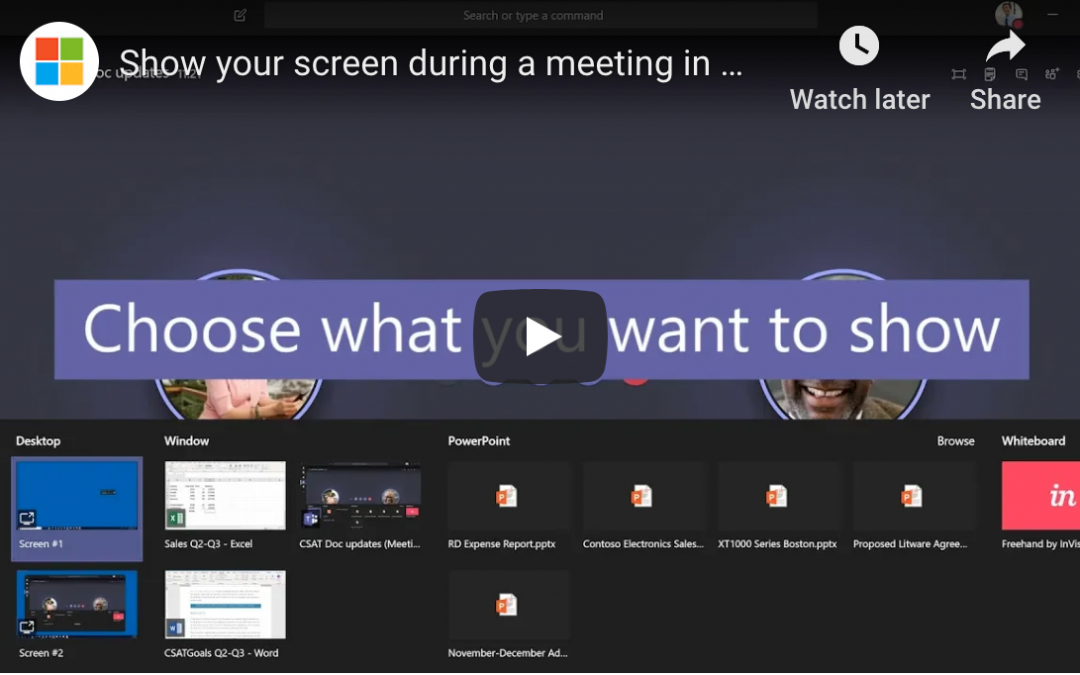
Screen sharing isn’t exactly new technology, but the implementation here is particularly well done. When you click the Share button, Teams doesn’t immediately share your entire screen. Instead, you have options. “Desktop” allows you to share one of your desktops. “Window” lets you choose a single window or app to share. “PowerPoint” shares the presentation you choose. There are even more options available under “Browse”.
Conclusion
This level of granular control makes screen sharing in Teams a killer feature, and there’s so much more that Teams can do for you. Team-based chat, productivity tools, and real-time collaboration on nearly any Office file are a few more ways it can help. If you’re ready to keep exploring, contact us to keep learning.