
by Felicien | Apr 26, 2019 | Education
The Tallahassee Democrat reported on April 5th that a large sum of money had been stolen from the city of Tallahassee’s employee payroll. The perpetrator is suspected to be a foreign hacker.
What was stolen in the hack?
The breech diverted approximately $498,000 from the city payroll account. Still, all city employees have received their earned paychecks. This hack was the second time in less than a month that a breach of city security had occurred.
How did the attack occur?
The city of Tallahassee employs an out-of-state third-party vendor to host their payroll services. Their employees should be paid regularly through direct deposit. However, a foreign hacker apparently targeted this third-party vendor, effectively redirecting the direct deposits to their own accounts.
The city of Tallahassee found out about the breach when their bank alerted them. Of course, employees found out simultaneously when they awoke to realize they had not been paid on payday.
Is there any way to get the money back?
In the majority of large scale hacks, stolen funds or data is difficult or impossible to retrieve. Still, with help from their bank, the city of Tallahassee has managed to recoup approximately a quarter of the stolen money.
They continue to pursue criminal charges against the hackers with the aid of law enforcement and their insurance provider as well.
How do cyber attacks like these occur?
Successful cyberattacks usually start with some form of an email hack. This is usually achieved through phishing.
In fact, before the most recent hack of the city of Tallahassee, an email had been sent out that appeared to be from the City Manager. It was actually from an outside hacker who had included a virus disguised as a Dropbox link in the email.
While it is not suspected that this email was related to the stolen payroll funds hack, this does happen. “Phishing” emails can help hackers procure useful information about accessing in-network files and accounts.
How can you prevent hackers from attacking your business?
Large municipalities such as Tallahassee City are increasingly being targeted in cyber attack thefts. But the truth is, any business — or individual, for that matter — can fall prey to a cyber attack.
Unfortunately, the retrieval rate on hacking thefts is not high, meaning that prevention is key. The best way to prevent a hack is to prevent phishing, as this is how most hackers access your systems and accounts.
Make sure that everyone on your staff is keenly aware of what to look for in terms of phishing emails. When in doubt, suspicious emails should be left unopened. Or, at the very least, links should not be clicked, and personal or account information should never be handed over unless it’s sure the request is legitimate.
It’s also important for businesses to employ the services of a reputable and experienced IT services provider. Look for one who specializes in cybersecurity and has experience dealing with hacking prevention.

by Felicien | Apr 24, 2019 | Education
If the thought of letting go of crucial parts of your business gives you the hives, it’s time to get real about outsourcing. It’s practically impossible for one individual or even a small group of people to adequately perform every function of a business. Even if you were able to hire specialists for each stage of your work — technology, accounting, payroll, human resources — would you really have enough work to keep a full-time asset occupied? Chances are, you need support in a way that would make a full-time hire the wrong decision for your business. You would either be hiring an extremely ineffective (yet low cost!) staff member who will be a drain on resources, or you struggle to perform multiple roles yourself. This leaves you with no time to focus and a poor experience for your customers. Fortunately, there’s a better way: outsourcing.
The New Outsourced Office
Outsourcing parts of your business doesn’t carry any sort of stigma and it doesn’t mean that you’ve failed as a business owner. What it means is that you’re being strategic with your time and determining where you are personally adding the most value to the business. Perhaps you need to know that your accounting and payroll are perking along in the background, but don’t have the expertise yourself to stay on top of the latest changes in legislation, compliance and tax law. This is an ideal situation for outsourcing to a trusted partner whose job it is to maintain compliance for your business. You’re effectively offloading that risk and stress from yourself or your staff to another organization, so you can focus on your core competencies as a business.
Focus Where It Counts
There’s something that makes every business unique, and that special sauce is the one thing that you don’t want to outsource. Everything else should be fair game for consideration, especially your technology and telecommunications infrastructure. The highly complex tasks associated with these operations can be expensive to hire outright, and difficult to find the right person for your needs. As your operations change over time, you may discover that you take your business in a different direction. This often means shifting staff members or expensive retraining for current staff. When you work with a managed IT services provider, you’re able to be much more nimble with technology changes and can expand your operations in a much more fluid manner.
Understanding when to outsource and when to maintain specific operations within your business can take time. Starting with a highly complex operation such as technology may give you the confidence that you need to outsource additional work so you’re able to focus on the core needs of your business — and to leverage your expertise towards exponential growth.
by Felicien | Apr 24, 2019 | Education
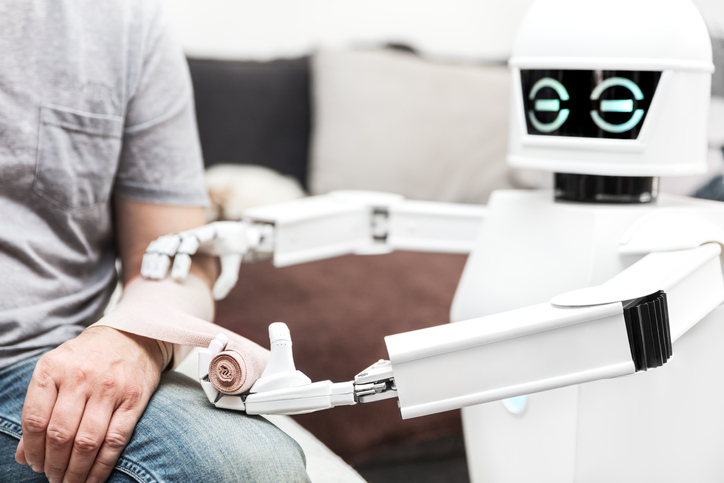
Artificial intelligence and robotics are poised to change the entire economic landscape over the coming decades, with an estimated 30% of existing jobs poised to be taken over by robots by 2030. Nowhere is this more evident than in healthcare. Many healthcare tasks are routine and prone to human error, making them prime targets for automation. At the same time, patients and ethics experts remain skeptical as to how robots may replace the expertise and compassionate presence of human medical providers.
Current Role of Robots in Health Care
Many people assume that robots in medicine remain years away, but the technologies currently deployed in medicine may come as a surprise. The first robotic device for surgical procedures, the da Vinci Surgical System, was initially approved by the Food and Drug Administration in 2000. It has performed more than 20,000 since, offering safe and reliable surgical interventions overseen by a human surgeon.
Surgery is not the only area of medicine where robots have made an impact. Powerful UV light-emitting robots disinfect surfaces and entire rooms, reducing risk of hospital-based infections such as MRSA or C. diff. Prosthetic robotic limbs interface with the nervous system to restore movement and the sense of touch to amputees. Automated dispensing robots limit medication dispensing errors in pharmacy settings. And clinical training robots offer lifelike simulations of medical conditions to help doctors during their training.
Future Applications of Artificial Intelligence and Automation
With each year, the role of automated systems in health care continues to expand. Industry experts predict a major shift in how health care is delivered over the next few decades. For example, robots are perfectly poised to increase access to medical services in rural or underserved areas. In a telehealth model, robots may collect routine clinical information such as a patient’s blood pressure, heart rate, breathing, and presenting symptoms. A remote specialist can then use the clinical information to make a diagnosis and offer a treatment plan.
Robots may also be deployed in rehabilitation settings to assist with physical therapy for patients with spinal cord injuries or neurologic diseases. Integrating robotics with virtual reality can help patients improve mobility, balance, strength, and coordination.
Human-sized robotics systems are not the only ways that robots may revolutionize medicine. Microbots or nanobots are tiny mechanical devices being developed to deliver drugs to specific sites. Currently, chemotherapy and other medical interventions cannot be specifically targeted to one area of the body. Researchers are developing microbots and nanobots made from biodegradable materials that can deliver medications without being attacked by the human immune system.
Limits of Robotics in Health Care
Despite the advantages of artificial intelligence and automation, there are significant drawbacks when considering how to provide high-quality clinical care. Take, for example, the experience of Catherine Quintana, whose 78-year-old father was taken to Kaiser Permanente Medical Center in Fremont, CA, due to chronic lung disease. Quintana was shocked when a robot rolled into the room to deliver some medical news — that her father was dying and that the only remaining treatment was palliative care.
Though extreme, this example points to one of the fundamental limitations of automation in health care. Even with cutting edge automation technology, robots are incapable of passing as humans. In particular, they cannot convey human emotions and struggle to handle complex questions. This limits the role of robots in health care. Though they may be used for some types of automation, when it comes to discussing complicated chemotherapy regimens with an oncologist or delivering the news that a loved one has Alzheimer’s disease, we continue to crave human touch.
Despite these limitations, robots have a clearly defined role in our medical landscape. Routine tasks with a high potential for human errors are perfectly poised to be taken over by automation. The ultimate question is how we, as patients, will react and adapt to this new era of robotic medicine.

by Felicien | Apr 24, 2019 | Education
April 24th is Administrative Professionals Day, which is an occasion worth celebrating. No office can function without hardworking and dedicated administrative staff, so why not take this as an opportunity to remind them how much you value them?
Treat your administrative staff to a little something special today, and let them know how important they are to everything that your business does.

by Felicien | Apr 23, 2019 | Education
Microsoft’s first version of the Edge browser fell far behind other options, gaining only a 4.4 percent market share compared to Chrome’s 65.5 percent, Internet Explorer’s 9.83 percent, and Firefox’s 9.62 percent. The company went back to the drawing board and created a new Edge that is based on the Chromium engine. Here are a few of the highlights that this new browser has to offer.
Better Compatibility
The original Microsoft Edge, based on EdgeHTML technology, ran into occasional problems with rendering HTML 5 elements. The new version has comparable compatibility to Google Chrome. Even in this early stage, most websites were rendered without any significant problems.
Changing Menus
The dockable pane is getting booted in favor of cascading menus. The options aren’t changing a lot, but the navigation feels more intuitive with this update.
Improved Data Privacy
One sticking point that some people have with Google Chrome is that the company collects a wide range of information about online activities from its users. You can use the latest version of Microsoft Edge to reduce the data that Google collects. Only the time you spend using Google properties such as Gmail get tracked, but your activity outside of that would not go to the search engine giant.
Supports Chrome Extensions
Microsoft Edge Insider Add-on selection has always paled compared to Chrome’s, but that’s not going to be a problem anymore. The new browser makes it straightforward to add Chrome apps, which is a huge upgrade to the user experience. Instead of only having 120 extensions to choose from, you have access to more than one hundred thousand. The Add to Chrome button will also work with Edge.
Synced Tabs
This feature isn’t in the new Edge yet, but you’ll eventually have all of your open tabs synced between your devices that have Edge open. It promotes seamlessly going back and forth between desktops, laptops and mobile devices.
Getting Microsoft Edge
This browser is currently under development so hasn’t reached the shippable stage yet. Microsoft will add more of the user-friendly features as the browser progresses. The early release performs well and comes in a daily and weekly updated version. It has a surprising amount of polish for software that’s relatively early in its development process. You can access the browser through the Microsoft Edge Insider program.
More Default Search Engine Option
Microsoft promoted Bing as the default, and only, search engine for Edge. The Chromium version is adding Google, DuckDuckGo and Yahoo to the roster. This is a welcome change, as having to go directly to the other search engines to use them made the user experience feel clunky.
Microsoft is taking a lot of steps in the right direction with the Edge Chromium version. It addresses many common complaints about Edge, and the disconnection from Google services limits the amount of data being collected. Following its development and seeing whether it can improve its foothold in the browser market will be exciting to watch.

by Felicien | Apr 23, 2019 | Education
The healthcare industry is currently facing a crisis. Hounded by criticism of insufficient access to providers and poor bedside manner, skepticism abounds on the part of patients and their families. But with administrative tasks and paperwork at an all-time high, how can healthcare teams find the time to give their patients the attention and information they need?
Fortunately, digital communications have evolved in parallel, with new means for patient contact—from email through texts, apps through social media—developing with built-in security standards and measures. This wave of digital communications is smart to the potential risks of protected health information (PHI), and strives to be HIPAA-compliant wherever possible.
Ensure patients have all the content they need.
Today’s digital messaging lends itself to customization. Choose from emails, SMS text messages, designing your own app, using existing messaging apps (WhatsApp and its peers), social media, browser pages, and more.
From all of these potential avenues, the choice as to which is most appropriate will be clear based on the demographics of the patient population being served. While elderly patients might not be all over Snapchat, this group might tend towards a specific operating system and platform—e.g. the Apple iPhone—which could shed some light on the ideal communication platform to employ with them.
Formatting the materials to fit the platform being used while maintaining universal accessibility is another key consideration. But as the adoption of digital communication continues to grow and the number of solutions expands, these problems will be incurred less frequently.
Leverage AI for one-on-one attention—while saving clinical time.
The knowledge of which specific channels are preferred by patient populations being served can be used to build solutions that enhance the patient experience. For example, if 90% of patients access the provider’s website, a desktop-friendly chatbot could be a worthwhile investment.
Via advances in natural language processing (NLP), chatbots have been evolving to respond more appropriately to input than ever before. For patients, they reinforce an environment where it is not only safe, but even advisable for individuals to ask questions. These patients and their loved ones can get the answers they need without costing themselves or providers any additional clinical time.
Chatbot responses can be programmed to answer frequently-asked questions, as well as escalate potentially troubling scenarios. They can help handle feedback surveys and check-ins for patients who are post-op or who have chronic conditions. In fact, Gartner estimates that by 2020, 85% of consumer interactions will be managed using automated platforms like chatbots.
The form these AI interactions takes is not strictly limited to the written word. This flexibility in format allows accommodations to be made for any disability. People who have trouble seeing can use voice-activated platforms akin to Amazon’s Alexa device, so they can then hear the answers to their questions and use their voices to navigate through their options.
Sustain easy, consistent process automation.
Being able to program chatbots or other response-generating platforms to automatically provide content based on contextual cues ensures that information is delivered where it’s needed, and to resolve the questions patients, caregivers, and family members might have. Automation allows this to happen anywhere; patients are not bound to the clinic in order to resolve their queries, but rather can access the information they need anywhere—including in the privacy of their own homes.
Why not use these advances in the healthcare space to drive patient accountability, allow consistent communication, but also free up providers for situations where one-on-one attention is critical and does not lend itself to automation? Freeing up providers to intervene during emergencies or counsel patients emerging issues could drastically increase the rate of positive outcomes. Routine follow-ups and visits could be expedited, reducing their burden on clinical staff.
In fact, the use of digital platforms allows for the seamless integration of all of these solutions into patient administrations systems. This is how to render those systems the de facto central hub for patient communication and record-keeping. Using surveys to interact with patients also allows information and feedback to be gathered and automatically recorded to patient charts; everything from ‘bad days’ through missed appointments can be easily accounted for without any additional time spent by office staff.
This is a snapshot of where digital communications are currently, but it will only continue to evolve as the general public continues to incorporate these channels further into their lives. The most critical fact to keep in mind is that digital communication is what the public wants. For example, a recent Healthcare Communications survey in the UK found that 68% of patients surveyed wanted to be able to manage everything about their appointments online.
This might seem like a no-brainer as the number of digital consumes continues to grow with increased adoption. However, the fact that individuals are not becoming “burned out” on tech and digital communications but instead are seeking further avenues to implement it in their lives is significant. This bodes well for future implementations.
Staying ahead of the trends and making sure practices leverage the latest technology and communication will not only make sure patients’ needs are met, but will boost their morale and increase the likelihood that they will comply with provider recommendations.