by Felicien | Nov 21, 2017 | Education
Modern commerce has seen many businesses migrate to the Cloud. Having a centralized place where business data is secure and more easily accessible makes the lives of busy professionals easier. Not to mention the business-focused scalability and growth potential that Cloud-computing platforms offer.
Microsoft’s Office 365 has long dominated as the favorite Cloud-platform for business. With over 60 million users worldwide, Office 365 is popular among business users thanks to its familiar design and a wide collection of customizable features and tools.
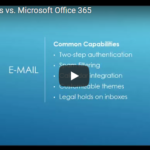
Google has recently charged onto the scene, unveiling their own Cloud-platform for business, dubbed G Suite. However, many business owners are wondering – is it living up to the hype and how does it measure up to the long-established Office 365?
Optimized Team Collaboration: Microsoft Teams vs Google Hangouts
Two of the most important elements of a successful business are strong communication strategies and a dynamic teamwork platform. If your team can’t connect and collaborate seamlessly, projects take longer to complete and morale can take a hit. Both Office 365 and G Suite have developed instant-chat platforms for team collaboration – let’s check out the features of each below.
Office 365: Teams
Microsoft unveiled Teams just this year as a built-in messaging app for Office 365. Teams blends a variety of collaboration tools into a single interface that helps employees connect without having to switch in and out of apps. This avoids having to switch to and from email to ask quick questions or get a stamp of approval on an important project.
Teams are equipped with group chat and international calling features, Skype & VoIP capabilities, and allows employees to connect in real-time as they’re working on other things. It also allows for the quick sharing of files and pertinent information while on a call.
G Suite: Hangouts
Google Hangouts has been on the scene for some time and many business owners have likely made use of the software for international calling and conference call meetings.
However, Google recently restructured Hangouts, and split the platform into two apps — Hangouts Chat for instant-messaging and Hangouts Meet for audio and video conferencing.
While both Teams and Hangouts offer dynamic collaborative power, the most attractive feature of chat-based tools is the ability to connect quickly without having to navigate between a variety of apps. While Hangouts in G Suite may be a good solution for businesses looking to divide their communication strategy into silos, Office 365 offers a much more seamless way for team members to connect in real-time.
Document Creation & Processing:
Creating and processing business documents shouldn’t be a tedious hassle. When it comes to putting together business projects, employees should have a seamless platform of programs that are easy to use and offer unique tools and features. Microsoft and Google have very similar platforms in this category – let’s explore each approach below.
Office 365: Word, Excel & PowerPoint
When it comes to document creation and processing, Microsoft Word undoubtedly is the most popular and widely used application on the market. It is the industry-standard word processing tool used on most computers around the globe. Almost everyone knows how it works, and countless professionals use it daily.
The application is designed to include built-in editing tools and hundreds of pre-stocked templates that help generate the most professional of business documents. Even better? Now that Office 365 is fully integrated with the Cloud, online, real-time document editing capabilities are available anywhere, anytime.
Most business owners are also familiar with Word’s trusted side-kicks, Excel and PowerPoint. Excel offers the ability to create dynamic and easy to track spreadsheets to help business owners keep organized and up-to-date. Furthermore, PowerPoint is constantly being updated with new templates and offers professionals a familiar and dynamic platform to create business presentations that stand out.
G Suite: Docs, Sheets & Slides
G Suite’s collection of apps are designed to mimic the package of productivity powerhouses in Office 365. Docs and Sheets – Google’s answer to Word and Excel – offer the ability for real-time collaboration of business documents using an online browser. However, in comparison to the Office 365 originals, the web-based interface for these apps can be irritating and tedious to navigate.
Slides, Google’s version of PowerPoint, offers a unique collection of stylish and well-organized presentation templates. However, like Docs and Sheets, the Cloud-based interface can be finicky and an annoyance for professionals trying to edit and format presentations and meet deadlines.
Access Control & Management
More and more, organizations are looking for increased access and sharing capabilities to enjoy the benefits of smoother workflows and stronger collaboration strategies. However, what about the ability to control and manage that increased access? Let’s break down the difference between the Microsoft and Google approach to administrative control.
Office 365: A Pilot Seat for Administrators
In Office 365, user control is built into every section. Office 365 administrators have full control to review and establish security policies around sharing content and inviting external users across various applications. This allows Office 365 administrators to create customized policy infrastructures to meet the unique security demands of their organization.
Office 365 offers extensive options in this area. If administrators take the time to implement security controls correctly and communicate them well with team members, productivity and collaboration in the Cloud will remain more secure than ever.
G Suite: Working to Match Microsoft
G Suite has been consistently challenged in this area because initially, Google offered a very limited set of security management features for IT administrators from within the Admin Console. Even now, businesses should carefully examine G Suite’s user controls, to ensure they cover the individual needs of different organizations.
However, G Suite has made strides in improving administrative control and they’re continuing to work on new strategies as well. Administrators can now more easily manage user accounts and control access and user permissions. However, they still have work to do in optimizing user access controls to match the strategic platform in Office 365.
So, Is Google Worth the Switch? Weighing the Pros and Cons
It’s clear that Microsoft has a tight hold on the market with a massive base of users across the globe. To be frank, it’s likely that Microsoft will always be the leader in enterprise collaboration and productivity, even though Google continues to make strides with G Suite optimization.
While G Suite has been picking up momentum, Office 365 has the legacy of Microsoft in their corner. Office 365 is familiar to business professionals, centralized, fully compatible and has had years on the market to work out bugs and optimize features. Simply put, Microsoft is the default – the go-to for business owners – and that in and of itself makes it a hard contender to beat.
While Google is making a name for G Suite and making strides with market deployment, they still need to work on developing a partner network for compatibility and building their image as a software vendor for enterprises. Additionally, G Suite is completely web-based and faces the challenge of proving how it could function as an offline platform – a problem Microsoft will never have to deal with.
Google offers a solid product with G Suite, but at this point, it’s very simple, and lacks many of the customizable features and optimizing power of Office 365. While G Suite development is definitely something for business owners to keep an eye on, for now, it’s safe to say that sticking with Office 365 is the best solution modern business strategy.
Cloud-computing is the future of modern commerce. The more technology continues to develop, the more capabilities business owners will have to optimize processes and drive connection. Microsoft is clearly leading the charge and it will be exciting to see how they continue to develop Office 365 for their huge and growing user-base.

by Felicien | Nov 21, 2017 | Education
How MIPS is Helping Physicians Manage Medicare Payment and Transform the Patient Care Experience
For a long time, US clinicians received Medicare payments based on a fee-for-service (FFS) model. However, this system was problematic for two reasons. First, it meant that physicians were forced to focus on the quantity of patients they could see instead of providing the highest quality of care. Second, it resulted in huge cuts to clinician Medicare payments across the board.
Despite annual attempts to fix the model, it was recently scrapped and replaced with the Quality Payment Program. This new model makes it easier for physicians to focus on giving quality care without having to worry about rushing through patient visits to ensure quantity quotas are reached.
Breaking Down the Model: What is the Quality Payment Program?
The Quality Payment Program reforms Medicare Part B payments for more than 600,000 clinicians across the country. The new model also helps to improve patient care across the entire healthcare delivery system, by putting the focus back on quality care instead of quantity of visits.
The Quality Payment Program offers clinicians two options:
MIPS – The Merit-Based Incentive Payment System
MIPS offers clinicians the possibility of Medicare payment adjustments based on the quality of care, practice improvement, advance care information, and resource use and cost.
Advanced APMs – Advanced Alternative Payment Models
Advanced APMs offer clinicians the possibility of Medicare payment adjustments based on the use of innovative Electronic Health Record (EHR) software.
What Are the Benefits of the Quality Payment Program for Physicians and Patients?
The Quality Payment Program (QPP) is defined by its ability to help physicians provide a better care experience so patients are getting the quality of care that they deserve. The reform of the FFS model and the implementation of the Quality Payment Program offers huge benefits for both clinicians and patients – let’s explore some of the key benefits below.
CLINICIAN BENEFITS:
Streamlined reporting
Standardized, evidence-based performance measures
Elimination of redundancies, which allows clinicians to focus on patient care
Promotes industry alignment through multi-payer models
Incentivizes care that focuses on improved quality outcomes
PATIENT BENEFITS:
Increased access to higher quality healthcare services
Enhanced coordination of care through a patient-centered approach
Improved health outcomes and results
Quality vs. Quantity: How Does MIPS Help Physicians Do Better and Optimize Medicare Payments?
For physicians who aren’t yet ready to adopt the Advanced APMs option, MIPS is the perfect starting point in Medicare payment model optimization. First and foremost, MIPS moves Medicare Part B clinicians to a performance-based payment system instead of the traditional per-visit payment model. Second, MIPS provides clinicians with the flexibility to choose the activities and quality performance measures that are most significant to their practice.
There are four MIPS Performance Categories and each is weighted on a 100-point scale:
Quality (60%)
Cost (0%)
Improvement Activities (15%)
Advancing Care Information (25%)
Note that these are default weights and that weight allotments can be adjusted in certain circumstances. Clinicians should aim to score as close to 100 as possible.
Because 2017 is the transition year from FFS to QPP, clinicians can choose the pace at which they’d like to participate in the new model: Test Pace, Partial-Year or Full-Year. To participate in the Full-Year category, clinicians were required to start submitting regular performance data as of January 1st, 2017.
To participate in the Test Pace category, clinicians must submit some amount of data after January 1st and before December 31st, 2017. For the Partial-Year category, clinicians are required to submit data covering a 90-day period, sometime after January 1st and before December 31st, 2017.
Each category, depending on data submitted, offers clinicians the ability to receive neutral or positive Medicare payment adjustments. However, those who do not participate in MIPS during this transitional year face a negative Medicare payment of up to 5%.
Does Your Practice Qualify? What Kind of Clinicians Are Eligible for MIPS Participation?
Clinicians eligible for MIPS participation must be Medicare Part B clinicians who are billing more than $30,000 per year and seeing more than 100 Medicare patients per year.
A variety of clinicians qualify under these conditions including:
Physicians
Physician Assistants
Nurse Practitioners
Clinical Nurse Specialists
Certified Registered Nurse Anesthetists
It’s also important to note that clinicians who have just enrolled in Medicare for the first time are not eligible for MIPS participation until the following performance year.
Don’t Miss Out: A Last-Minute Checklist for 2017 MIPS Participation
As noted, to participate in the transitional 2017 year and avoid a 5% penalty, clinicians MUST submit their 90-day period data by December 31st, 2017. That leaves less than a month for last-minute submissions. If you’re wondering what’s required, consult this quick checklist to make sure you submit all the data required:
Determine your eligibility status
Choose if you will be reporting as an individual or a group
Determine the Performance Categories most relevant to your practice
Collect and organize necessary performance data
Choose a data-submission option – Test Pace or Partial Year
Submit required data BEFORE December 31st, 2017 to avoid a negative Medicare adjustment
This is a condensed checklist to help with last-minute MIPS preparation, but there are countless resources online to help clinicians make the most out of MIPS participation. For full details, check out some FAQ’s here: www.saignite.com/industry-expertise/quality-payment-program/mips-education/10-faqs-about-mips/.
No matter what kind of care you provide, a Medicare payment model designed specifically to better support clinicians AND patients is a no-brainer. MIPS and the entire Quality Payment Program is based on a cycle of high-quality, patient-focused care, useful feedback from physicians and continuous improvement of the healthcare experience.
For physicians looking to better streamline processes, deliver better care and improve outcomes for all involved, participating in MIPS is a must. By focusing on enhancing the patient and clinician experience to improve overall care and service delivery, MIPS is an amazing and strategic tool that helps physicians refocus on quality care instead of quantity of visits.
If your practice wants to participate in MIPS for the 2017 transitional year, the deadline is fast approaching. December 31st, is the last day to submit performance data without facing a negative 5% Medicare payment adjustment.
If MIPS has your head spinning, don’t be afraid to reach out to local experts for guidance or consult other clinicians who may already be participating. A payment model that seeks to benefit both patients and physicians could hold huge benefits for the transformation of our healthcare system – make sure your practice doesn’t miss the boat!

by Felicien | Nov 20, 2017 | Education
Black Friday deals seem like they begin earlier every year. Most of the bigger retailers don’t even wait until Friday to roll out the specials on big-ticket or most wanted items.
As your trusted IT company, we are here to offer you some insight into this year’s tech deals. Whether it’s about a new 4K TV or how to get that great new gaming system running, we will do our best to help make your Black Friday tech shopping a bit less stressful.
But is it worth your time and aggravation to wait in line half the day or more on Thanksgiving, or should you stay home and overeat on turkey and stuffing? After all, the same retailers will have the same items available (mostly) on their website for the same prices and quantities, but with less physical violence over a toaster oven.
Every year Wal-Mart is the hub people pushing and fighting for the last set of pans or the last coffee maker. In recent years, Wal-Mart has moved Black Friday deals to Thursday night and there have been less of the crazy pricing and more handing out numbers to alleviate tensions and fist fights. Quantities are still limited and you’re going to have pushing and shoving over things like WWE 2K18 for $29, but what you should be worried about is whether it’s worth it to stand in line for $100 off an Xbox One S.
Speaking of the Xbox One S, Wal-Mart will have the 500GB model on sale for $189 (a savings of $110). Similarly, the PS4 will be on sale for $199, also a savings of $100. Wal-Mart is advertising that they will also have stock of the Nintendo Switch. No sale price, still $299, but considering you couldn’t find one anywhere all summer it’s an item worth braving the crowds for.
Of all three retailers we’ve covered, Wal-Mart has the best overall pricing on movies and games for Black Friday. Titles vary by location and not every title Wal-Mart has the competitors have, but if you are in the market to pick up a few low-priced gems for someone, this would be a place to look. A couple highlights are the Call of Duty Combo Pack (WW2 & Infinite Warfare) for $59, Horizon Zero Dawn for the PS4 only $19, and Overwatch for $29.
4K TVs are the gift of the year for 2017. Everyone wants to go 4K, and Wal-Mart has a wide selection of TVs to do just that. The best buy here would be the Sharp 4K 55” Smart TV. It does everything you want a 4K TV to do, and it comes with Vudu, Netflix, and more already installed, and it’s only $298! 55” not big enough for you? How about the 65” inches for $998, featuring built-in streaming apps and 4K Ultra HD.
Wal-Mart also has the Google Home Mini for $29, an iPad for $250, a Nintendo 2DS system that comes with The Legend of Ocarina of Time for $79, and everything you need to take your home into the next stratosphere with Google Home, a Netgear “Nighthawk” router for $89, and a home security setup.
Bottom line, Wal-Mart may be the better overall deal as far as movies and games go, but do you really want to brave the crowds for something that you can find online with free shipping for $35 or more. The 4K TV might be hard to pass up, but is braving an angry mob of shoppers worth the savings? Only you can know for sure.
{company} wants you to have a happy Thanksgiving and a productive Black Friday experience. Look for more Black Friday tips from us tomorrow.

by Felicien | Nov 20, 2017 | Education
Thanksgiving is almost here and like every year, the holiday serves as the perfect time to reflect on the people and the things we’re grateful to have in our life. Though we often take it for granted, something that everyone can be thankful for is the planet itself, and all the resources it provides. With a new season upon us, it’s the perfect time to remember just how grateful we should be for the environment.
However, in an increasingly crowded and competitive marketplace, the impact of modern business on the environment takes its toll. More and more, business owners are looking for ways to decrease their carbon footprint and take better care of the planet. Luckily, many business owners look to technology to help them ‘go green’ and reduce environmental impact. And as it turns out, going green does not have to negatively impact business budgets.
The Planet Will Thank You: How Businesses are Using Technology to Go Green
Taking care of the environment is critical, but many business owners understandably worry about the costs associated with reducing their carbon footprint. However, tech innovation is making it easier than ever for professionals to make decisions that are smart for business and the environment. Modern technology means that profitability and environmental sustainability need not be mutually exclusive.
Whether a business is looking to go paperless, cut power usage or reduce business travel, technology offers an increasingly wide range of solutions that can help business owners play their part when it comes to environmental sustainability – while also staying within or below budget. Budget-friendly and environmentally-friendly? What’s not to be thankful for?
Let’s look at the top 3 strategies for going green with business technology:
Environmentally Friendly Tech Strategy #1 – Go Paperless
This one is straightforward. The less you need paper in your office, the fewer trees will be cut down to supply it. More trees in the forest mean more oxygen for the planet and so on. Most businesses have already made the switch to digital, but if you’ve been putting it off, the time is now.
Switching from hardcopy documentation systems to digital or cloud-based platforms isn’t just about saving the trees either. Making the switch poses huge business benefits as well. Sick of that chaotic desk full of paperwork? Wondering where you put that important invoice? Shocked at how much you’re paying for ink? In addition to helping the environment, going paperless saves time, sanity and capital.
Environmentally Friendly Tech Strategy #2 – Cut Power Usage
Safe to say most business owners would agree that a reduced hydro bill would be nothing to complain about. Technology is great for business, but many business owners realize that the more devices used onsite, the higher the electricity bill.
However, as technology continues to evolve, devices are being designed with power-usage in mind. Proper recycling of old servers, computers, and printers to make way for new, power-friendly replacements may seem like a big investment, but in the long run, the planet – and your wallet – will thank you.
Environmentally Friendly Tech Strategy #3 – Reduce Business Travel
One of the greatest things about the modern business world is that businesses can operate across the globe. No matter the industry, a growing number of businesses are expanding into international markets or working with vendors from across the globe.
Worldwide business is great, but getting face-to-face with international clients or service providers can result in a lot of cross-country flights and air pollution. Not to mention the cost of roundtrip business flights, plus accommodations. Luckily, technology has an answer for that too. Expanding communication capabilities like Skype and remote access solutions minimize the need for unnecessary travel and make global collaboration a breeze.
We live in a fast-paced and increasingly tech-based business environment. Technology is transforming everything about modern commerce. It’s a no-brainer that we should be using tech developments to improve our relationship with the environment as well. That’s why, as your counting your blessings this Thanksgiving, be sure to reflect on how lucky we are to be able to breathe the air and think about how your business can reduce its environmental impact.
There is nothing more important than protecting the habitat we all share, and technology can empower business owners to do just that. The best part? Between savings on paper, power and travel, going green is defined by cost-reduction. For business owners looking to stay competitive in a modern business market, staying environmentally friendly is just good business sense.
If your business is looking to reduce your carbon footprint, take a look at your technology infrastructure. Find out areas for improvement and make sure your network is set up to help you and the environment.
If you need a hand implementing some environmentally friendly tech strategies, reach out to a local technology firm for a consultation. Doing your part for the planet doesn’t have to mean a hit to your bottom line.

by Felicien | Nov 17, 2017 | Education
Black Friday deals seem like they begin earlier every year. Most of the bigger retailers don’t even wait until Friday to roll out the specials on big-ticket or most wanted items. We are here to offer you some insight into this year’s tech deals. Whether it’s about a new 4K TV or how to get that great new gaming system running, we will do our best to help make your Black Friday tech shopping a bit less stressful.
Once again, this year the deals (and lines) will begin at 6:00PM on Thursday, Thanksgiving Day at most retailers. But is it worth your time and aggravation to wait in line half the day or more on Thanksgiving, or should you stay home and overeat on turkey and stuffing? After all, the same retailers will have the same items available (mostly) on their website for the same prices and quantities, but with less physical violence over a toaster oven.
First, we’ll look at Best Buy. The electronics giant seems to be bucking trends and will open at 5:00PM Thursday night, then reopen at 8:00AM Friday morning. Their ad is highlighted by 4K TVs and deals on video games, movies, and phones/tablets. The 4K TVs have savings ranging from $150 off to $350 off, depending on brand and size. In particular, the Sharp 50” 4K TV is only available in stores and will be on sale for $180, a savings of $320!
There are savings (albeit small) on Amazon Kindle Fire, Apple iPad Mini 4, and loads of accessories for your TV or gaming system. Several Chromebooks are also on sale, most over $100 off. The big one to watch here is the Microsoft Surface Pro Core M, which is on sale for $629 (that’s $370 off!).
On the gaming side, Best Buy is offering a PS4 1TB console for $199, a savings of $100 off retail. That’s a good deal for the PlayStation fan on your list. Best Buy will have the Xbox One S 500GB console for $229, which is $40 more than both Wal-Mart and Target. However, getting the console at Best Buy will also net you a free second wireless controller and a downloadable copy of Madden 18 video game. This amounts to $50 off the console and $120 worth of extras for free. Or you can get the Xbox One S on its own for $189, which matches Wal-Mart and Target’s price. Either way, expect quantities to be severely limited.
If you’re desperate for a new 4K TV or getting that free football game with your Xbox, I suppose standing in line could be viable. But in all honesty, is it worth it when you could be sitting on your couch and order the same items from your phone, getting the same deals and free shipping?
CompNetSys wants you to have a happy Thanksgiving and a productive Black Friday experience. Look for more Black Friday tips from us tomorrow.

by Felicien | Nov 17, 2017 | Education
Discover how to use Microsoft Outlook to ensure HIPAA compliance and avoid costly fines. It’s a complex process, and you need to know the ins and outs.
Is Microsoft Outlook HIPAA compliant? The straightforward answer is “no.” Companies do not achieve HIPAA compliance by using it on its own. Steps must be taken to ensure compliance with HIPPA and HITECH’s Act. Keep in mind that there isn’t any email platforms or software that can be fully compliant. It’s more about how the technology is used. It also depends on which version of Outlook is used. In general, for an email service to be HIPPA compliant, it must have security features to ensure that the interception of sensitive data cannot take place. In addition, platform providers must sign a Business Associate Agreement (BAA) with HIPPA-covered organizations. This agreement covers security, privacy, and breach notification regulations. While Microsoft has already taken action to make its services suitable for healthcare providers by using a BAA, it doesn’t cover all of the company’s services and software.
A Close Look at Outlook and Office 365
The Outlook email platform and Office 365 are two different products. This email platform should not be used by healthcare entities. Office 365 is appropriate for healthcare organizations and has the BAA. However, it must be the right version – Enterprise E or E5. These versions can be HIPAA compliant because they have the ability to wipe data on mobile devices, have data loss prevention and offer encryption. At the same time, these versions must incorporate :
Maintained audit logs
Configured properly
Sign on and factor authorization enabled
Data backups
Employee training
It is these features and controls that make it HIPAA compliant. It’s important to note that signing a BAA doesn’t equal HIPAA compliance. According to Microsoft, “Your organization is responsible for ensuring that you have an adequate compliance program and internal processes in place and that your particular use of Microsoft services aligns with HIPAA and the HITECH Act.”
What Is HIPAA and the HITECH Act
Both of these acts are US federal laws. These acts are designed for healthcare organizations and companies, such as hospitals and physician offices. They focus on the requirements for the safeguarding and disclosure of individual health data. Plus, they also require signed BAAs, which focus on security and patient privacy.
Healthcare organizations can use the Exchange Online Protection (EOP) to configure Outlook 365. It’s a cloud-based email filtering service that wards against malware and spam. There are also additional features to safeguard against messaging-policy violations. All around, being HIPAA compliant can be achieved with the proper configuration.
Healthcare organizations can create HIPAA DLP policies right in Office 365. “The default HIPAA rules scan emails and use ‘U.S. Social Security Number (SSN)’ or ‘Drug Enforcement Agency (DEA) Number’ as triggers. Additionally, U.S. Passport Number, U.S. Bank Account Number, U.S. Driver’s License Number, U.S. Individual Taxpayer Identification Number (ITIN) can be added to the checklist from available templates.”
Ensuring HIPAA compliance requires proactive strategies and using the right technology. HIPAA violations and compliance issues are costly. The cost of not preventing these incidents can tally up to $1,000 for each breach. As more and more healthcare organizations are electronically transmitting patient records to medical facilities and specialists, it’s important to ensure that all of that information is secure.
HIPAA Compliance and the Cloud: It’s Complex
Today, more and more healthcare organizations are moving their electronic communications to the cloud to save money. This transition allows for a cutback in storage expenses and hardware. At the same time, it expands the scope of HIPPA regulations. Healthcare organizations must also ensure that their vendors are HIPAA compliant. This makes it more difficult than ever to maintain compliance. “When a covered entity enlists a cloud service like Microsoft Office 365, Gmail, or Google Apps for Work for email and file sharing, that entity’s digital information must be stored on and shared across that vendor’s servers.” Clearly, one can see why it’s so difficult to stay compliant.
Vendors must complete preventative tasks and stay HIPAA compliant also, such as:
Establishing procedures for a security breach
Implementing procedures for audit logs, access reports, and security tracking
Assigning unique indicators for identifying employees
Training employees
Tips for Staying HIPAA Compliant
It’s always smart to get a HIPAA compliance scan once a year. This type of scan is designed to pick up on everything. You also need to get a domain. It’s centrally managed and included security features. Add encryption to all of your mobile devices. It’s just one more strategy to keep your data safe and secure. Manage passwords and automatic log off. It’s the easiest way to meet HIPAA standards. Keep in mind that HIPAA standards also require a business-level email with end-to-end security. Use a business-grade firewall. These firewalls are equipped with extra security features to ward off a security attack. In addition, use an outsourced IT company or have an in-house professional IT staff. This will help ensure that security updates are well-monitored and consistently implemented. While becoming and staying HIPAA compliant is a complex process, you can close the security gap with the right steps and strategies. Do it right, and you can avoid those costly and unnecessary fines. If your healthcare organization needs help with becoming and staying HIPAA compliant, contact a third-party IT management company to learn more about the process.