
by Felicien | Jan 16, 2018 | Education
Alexa, Amazon’s incredibly smart voice-activated assistant, is capable of just about anything – from ordering a pizza to calling a taxi to turning on the smart bulbs around the house. Alexa truly enhances the lives of those who use it, and it’s recently become even smarter than ever before! How? That’s simple: Alexa has joined forces with WebMD, the leading source for the latest health and medical news.
Medical Guidance – Just One Short Voice Request Away!
Is it just a stomach ache or something worse? Now it’s easier than ever to find out! Amazon’s Alexa is adding medical advice to its set of more than 10,000 skills. Just when you thought the virtual assistant couldn’t get any smarter! The software will offer users WebMD’s content library to give them the most accurate, up-to-date health information possible. All enabled devices, including Fire TV, Echo, and Echo Dot, will allow users to ask health-related queries on a wide range of topics:
Treatments for common ailments
Definitions of various conditions and diseases
Side effects of prescription drugs
And much more
Ben Greenberg, WebMD’s Vice President of Mobile Products, told The Verge, “We want to be in the place where we believe computing is going, “[This] is going to be really helpful in situations where you want to access something hands-free. For example, a mom with her baby. The baby’s got a rash and is on amoxicillin, and there’s poop all over the place and it’s scary. The mom can find out that diarrhea is a side effect of amoxicillin, without having to navigate through a visual interface.”
He also stated, “There are a number of reasons that voice-enabled interfaces are growing in popularity – they are generally hands-free, people can talk faster than they type, and when done right, they make it easier for consumers to quickly and easily get to the information they need.”
Health-related queries will be responded to with physician-reviewed answers in plain, accessible voice. The option to request additional information sent in text form will also be available if needed. When this option is selected, you will also receive a URL to a WebMD page for more resources.
Ready to Make Use of Your Favorite Virtual Assistant’s Newest Feature?
If you’re ready to get started, simply add the skill via the app store. Go to the sidebar menu button in the top-left corner of the app screen, then type “WebMD” inside of the search box and search. Once you’ve found it, install and start your command with “Alexa, ask WebMD…” Just remember, despite physicians verifying the information you’re given, it’s always best to go to your doctor with any serious concerns.
However, for those times where you want to learn more about a pre-existing condition or hear about the side effects of a prescription drug, the feature is great! It’s especially fantastic if you’re not able to pick up your phone or laptop.
Eventually, WebMD would like to make various updates to improve the interface while adding the ability to ask follow-up questions. Greenberg stated, “The voice part of it is a crucial investment to where we will be one day. Our grandkids will make fun of us forever having used a keyboard!”
Other Health Integrations You Might Be Interested In…
Aside from WebMD, Alexa has a few other interesting health integrations users might be interested in. Over a year ago, Alexa teamed up with Fitbit, a company known for its wearable products designed to keep track of user’s health data. This partnership allows you to track important information regarding your sleep, activity, and weight anytime from your tracking wearables.
Boston Children’s Hospital also partnered with Alexa to create an app known as KidsMD – giving parents vital details on their children’s health conditions and medications. In the future, we’re sure to see more health integrations coming. Rob Pulciani, Director of Amazon Alexa, stated, “we’re excited that WebMD is bringing its skill to Alexa.”
Pulciani continued, “With the WebMD skill, customers can get answers to health questions simply by asking Alexa. It highlights the convenience of a more natural spoken language experience.”
Recent studies have shown that the number of people turning to the Internet for information on a diverse range of health subjects continues to grow at a rapid rate. In fact, according to Google, 1% of its searches are health-related. This showcases the strong need for WebMD and Alexa’s partnership.
Who is {company}?
{company} provides the highest quality IT support around – from building and developing infrastructure to offering timely support when needed to keeping systems backed up and recoverable at a moment’s notice. We keep our clients up and running because we know avoiding downtime is vital to staying competitive in today’s marketplace.
by Felicien | Jan 15, 2018 | Education
Many of us are guilty of using the same password, or a variation of the same password, for our personal and business-related accounts. Unfortunately, these bad password habits only make it easier for hackers to steal our information. When they do, they hold that information for ransom or use it to gain access to our bank account or our clients’ information.
Hackers use a variety of methods to obtain that information. For example, hackers will monitor public Wi-Fi, intercepting the usernames and passwords you enter. You can outsmart these cyber criminals by making sure not to log in to any of your accounts when on public Wi-Fi.
Hackers also use programs that contain droves of stolen information. All they need to do is search a username or password and hope they get a hit. If they do, hackers can access your accounts and information.
Hackers will go to any length to gain access to your information. They steal your passwords, install keystroke loggers, and sometimes use brute force. If a hacker wants your information, they will do everything in their power to get it. Therefore, we must protect ourselves. We cannot use the same password or variation of a password for all of our accounts.
Once a hacker has your information, they will retreat to the dark web. The dark web is essentially the parts of the Internet that require special software to access, meaning you cannot access it using a regular web browser like Internet Explorer or Chrome. Everything that happens on the dark web is anonymous, so naturally half of all activities that take place there are illegal, including the sale of account credentials.
You may not have access to the dark web, but there are still ways to find out if your information is on the dark web. With a Dark Web ID scan, CTC Networks can determine if your personal information is vulnerable. We go into the dark web so that you don’t have to.
Dark Web ID Scans
A scan of the dark web will show CTC Networks if your information is visible in any corner of the dark web. Once you know what information is vulnerable, you can change those usernames and passwords, which will help ensure that hackers stay out of your accounts.
CTC Networks provides:
Dark Web Threat Alerts – Proactive monitoring of your organizations stolen or compromised data and real-time alerts when we find your information.
Compromised Data Tracking and Reporting – Track and triage incidents to better manage risk.
Compromised Data Trending and Benchmarking – Gain insight into your organization’s current threat posture while benchmarking it against your peers and the industries that you serve.
Supply Chain Threat Monitoring – Monitor your supply chain, third-party partners, and vendors to understand the potential risk they pose to your organization.
Customer Management – Better protect your customers by providing them actionable recommendations to help protect against potential data breaches.
By enlisting the help of CTC Networks, you can make sure that your sensitive information is safe. Awareness is important for keeping both your and your clients’ information safe.
Check now and see if your information is on the Dark Web.
Let the experts at CTC Networks ensure your safety. They will scan the dark web for any mention of your information before it is too late. Call (615) 550-0020 for more information.

by Felicien | Jan 15, 2018 | Education
The adoption of seemingly futuristic technologies is creating a new reality in healthcare today. The following are some of the remarkable healthcare technology advances of 2017.
The Leadless Pacemaker
The pacemaker has come a long way since the 1960s when investor Dr. Wilson Greatbatch accidentally invented it. Today, leadless pacemakers have demonstrated high rates of implant success. Companies like Medtronic and St. Jude Medical have created versions that reduce potential risks such as serious infection, venous stenosis or occlusion, and tricuspid valve insufficiency.
Augmented Reality for Healthcare Education
It’s estimated that the U.S. needs 96,000 more doctors to meet the current healthcare needs of the national population. During their years of education, physicians are put through a gauntlet of requirements. However, with 3D training solutions, doctors can now learn about anatomy without having to cut open a cadaver. These software tools use CT and MRI scans to convert them into 3-dimensional holographic images of tissues and organs so students can interact with them as if they were real. Medical 3D imaging isn’t new, but with today’s technology, organs seemingly “pop out” of the screen and can be manipulated virtually to provide a real-life experience.
Patient Access Solutions
Did you know that less than 10% of hospitals use digital record systems? What’s more, only 54% of referrals that are faxed result in scheduled appointments? Seems archaic, right? This causes backlogs and inefficiencies, not to mention a negative impact on patients’ health. Now there are software platforms that can help providers and staff route patients to the most appropriate, high-quality clinician in a community. Plus, they can integrate this information into an EMR system.
Diagnosing Solutions
Diagnosing patients has always been a challenge without in-depth testing. Soon, we may have devices that can identify ailments in seconds, versus hours or days: Final Frontier Medical Devices, a Pennsylvania-based team led by brothers Dr. Basil Harris (an emergency medicine physician) and George Harris (a network engineer) took home the 1st place XPRIZE for their artificial intelligence-based engine that learns to diagnose medical conditions. It includes a group of non-invasive sensors that collect data about vital signs, body chemistry, and biological functions to make a quick and accurate diagnosis.
Warm Blood Perfusion System for Organ Transplants
Cardiac transplantation is now a realistic solution for people with severe heart failure that can’t be remedied by other therapies. Survival among transplant recipients has improved as a result of treatments that suppress the immune system and prevent infection.
Unfortunately, the number of heart donors has plateaued—it’s estimated that 50,000 people are candidates for cardiac transplantation, but only 5,000 transplants occur each year. Typically, surgeons in the U.S. preserve organs in a cold solution and transport them in coolers to patients in need. However, this can result in damage to the heart, and in some cases, render it unusable.
Thankfully, a new process called warm perfusion keeps hearts beating and lungs breathing so doctors can assess and treat organs to make them last longer. This has the potential to reduce the chronic shortage of hearts and other organs for transplant by expanding the pool of usable ones.
Advanced Cancer Treatments
Acute lymphoblastic leukemia is extremely difficult to treat and progresses rapidly—most patients die within a few months. Now, scientists at Juno Therapeutics put 24 of 27 adults with refractive acute lymphoblastic leukemia into remission, and six patients have remained disease free for more than one year. The use of human T cells has the potential to revolutionize the way cancer is treated and can be effective regardless of the type of previous treatments that patients have undergone. Patients can also avoid the long-term side effects from current treatments.
In Silico Clinical Trials
Clinical trials in their current form take many years to complete. Testing a single compound can cost more than $2 billion in the U.S. due to FDA regulations. The process is long and tedious. Now, researchers at Wyss Institute have developed microchips that replicate the functions of human organs. These microchips, called “organs-on-chips” provide an alternative to traditional animal testing. Each individual organ-on-chip mimics the physical microenvironment of living organs, including breathing motions in lungs and deformations in the intestine. They provide a window into the inner workings of human organs.
3D Printed Drugs
3D printing has been around for many years and has been used mostly in manufacturing. It has now expanded into the healthcare industry where it’s used to create custom prosthetics and dental implants. Now, 3D printing may also change the pharmaceutical world forever:
Personalized drug dosing Researchers can now produce personalized 3D printed oral tablets. This may be helpful for patients who respond to the same drugs in different ways. A doctor or a pharmacist would be able to use each patient’s individual information to produce their optimal medication dose, rather than relying on a standard set of dosages. Pills could be printed in a complex construct of layers, with a combination of drugs to treat multiple ailments at once. In this way, a single pill could be used for everything.
Unique dosage forms 3D printing could also be used to create unique dosage forms during the production process. It’s already been tested for many drugs, and we should see more innovation in the future.
More complex drug-release profiles Drug-release profiles detail how a drug is broken down when taken by the patient. 3D printing makes it possible to print personalized drugs that make them release as they should. They build a barrier between the active ingredients so researchers can study the variations of the release more closely.
Young Blood Anti-aging
There’s a new treatment in the making where the blood of people under the age of 25 could be used to reverse the effects of aging. Companies like Alkahest are identifying the key proteins in plasma that can rejuvenate human tissues and then hope to manufacture a product that uses them. This will likely take 10 to 15 years to complete. However, over the next two years, Alkahest plans to take human plasma and divide it into fractions and test them in mice to see if they boost brain function. If they do, they’ll be used in human trials and developed into the first generation of blood anti-aging products.
The Internet of Things for Healthcare (IOT)
IoT is the inter-networking of physical devices, connected devices (like vehicles) and “smart devices” (such as buildings, and other items) that are embedded so they can collect and exchange data.
Now, patients can use the IoT in healthcare. For example, hospitals use it for real-time location services with badges that can track patients, staff, and medical devices. Infusion pumps, wheelchairs, defibrillators, scales and other items can also be located via the IoT.
With Internet of Things devices, clinicians can see what’s going on in operating rooms and determine when patients are ready to be transported to the PACU (post anesthesia care unit). Plus, the IoT helps when checking temperatures of refrigerators or IT closets — as well as for monitoring hand-hygiene compliance.
Consumerism in Healthcare
Today, patients are more like consumers in that they have a choice in their healthcare options; they make the best decisions for quality and cost just as they do with any other product. This trend has been accelerated by the Patient Protection and Affordable Care Act, which left many consumers with large deductibles to find the most cost-effective care. Companies like referralMD, Healthgrades, and Vitals are capitalizing on this by offering patients and providers tools to gauge which providers are both cost-effective and high quality.
BioElectronics
GSK’s Bioelectronics R&D unit is pursuing a scientific field that could one day result in a new class of medicines – miniaturized, implantable devices. These devices could be programmed to read and correct the electrical signals that pass along the nerves of the body to treat diseases like inflammatory bowel disease, arthritis, asthma, hypertension and diabetes without pills or injections.
Cognitive Computers
In the future, more health systems will leverage advanced computer systems to provide clinical support for their patients. At present, the volume of healthcare data is about 150 exabytes. At the projected growth rates, the volume of healthcare data will soon be at the zettabyte and yottabyte scale. These computers can process 500 gigabytes/second. We’ll start to see more companies using cogitative computers and licensing them for healthcare professionals around the country.
Genomics Editing/Splicing
Genome editing makes specific changes to the DNA of a cell or organism. An enzyme cuts the DNA at a specific sequence, and when repaired by the cell, a change or ‘edit’ is made to the sequence. Intellia is a genome editing company that is focusing on the development of curative therapies. They believe their technology has the potential to transform medicine by permanently editing disease-associated genes in the human body with a single treatment course.
Bioabsorbable Stents
Every year, 600,000 patients have metal coronary stents implanted to treat coronary artery blockage. Most of the time, these stents stay in place forever. Now, the first bioabsorbable stent is available. It’s made of a naturally dissolving polymer and acts much like dissolvable sutures. The stent widens the clogged artery for two years and then disappears, leaving a healthy natural artery. Even better, recovery time has now been reduced from four weeks for metal stents, to just a few days with the bioabsorbable stents.
Thanks to technology, these and other advances have the potential to change the fabric of healthcare for the better and reduce the risks we would otherwise face.

by Felicien | Jan 15, 2018 | Education
LinkedIn is the most popular business and employment-focused social networking site around. Whether you’re happily employed at a fantastic company or you’re still searching for your dream job, it’s simply a must-join site for your professional future.
LinkedIn users not only have the ability to connect with people in an effort to grow their networks, but users can also connect with companies through the following feature. When you follow companies, you’re able to see:
Status updates and important news
People who work for the company
Available positions waiting to be filled
And much more
As you can imagine, this is handy if you’re looking to fill your sales pipeline or find a new job. Prior to connecting with companies, it’s important to consider that there are more than 300 million people worldwide using the social networking site, which means you need to put your best foot forward! If you’re starting a brand new profile, remember the first few lines are the most important – name, title, and most recent positions.
Those first few lines will show up in any search, so you want them to be accurate and informative while giving you a good first impression. Your photo will also show up in any search, so you want to make sure you’re using an updated, clear shot. Another great tip before you start connecting with companies: customize your URL! How do you do this? That’s simple:
Click the “me” icon at the top of your homepage
Click view profile
Click edit your public profile and URL on the right rail
Under edit, public profile URL in the right rail, click the edit icon
When you first join, you’ll have a very long, impersonal URL. This is the time to change it to something more personal and professional. Aim for http://linkedin.com/in/firstnamelastname. If that’s not available, include something like a middle initial or even something alluding to your industry or expertise. This is great for searchability.
Next, write your summary. LinkedIn’s summary section is fantastic for showing off your personality and skills. You can include high-resolution photos, videos, and infographics as needed. Or you can keep it simple with text only – just be sure to stand out. Think of the summary section as your elevator pitch and keep it interesting.
Once you’ve set up your profile, you’re ready to start connecting with companies! So what’s the best way to get started? If you know the niche you want to work or find leads in, look for companies using the search engine. You can either search for a company name directly or use keywords having to do with your niche. Once you’ve found what you’re looking for, click “follow company” to connect.
You’ve Connected with a Few Companies… What Next?
First and foremost, connect with us! Our team is your trusted source for the latest information when it comes to business technology. We have extensive expertise and knowledge of the small to mid-size market; and we’re always sharing tons of great news, tips, and more. What’s next? Well, after you’ve connected with us and a few companies of your choice, follow these tips:
Start interacting with recent posts: Make sure you’re liking and commenting on posts, especially if you have some good insight to share on the topic. Always ensure you’re using proper spelling and grammar, of course!
Check out the leadership team: You should be able to find those who work for the company, including CEOs and Presidents, on the right side of the company page. Feel free to send invitations to connect.
Keep on the lookout for positions: If you’re looking for a job, make sure you keep an eye out for opportunities. If you’re looking to provide services, positions available can give you an opening to offer your services instead of hiring a full-time person.
LinkedIn groups are also useful for finding companies. Just search for groups relevant to the industry you’re looking for a job or leads in. You’ll easily find members of groups that are working at relevant companies.
What About Connecting with the Competition?
If you’re connecting with companies for the purpose of building your sales pipeline, should you connect with the competition? This can be a great tactic to help you gain a better understanding of your target market. How so? Once you’re connected, you’re able to view who they’re connected with – from prospects to clients.
Aside from being able to keep an eye on their prospects and clients, you’re also able to get a great view of their marketing strategies, including:
The content they’re sharing
The webinars they’re hosting
The events they’re holding
And much more
Keep in mind that you’re giving your competitor’s access to all of the same information. For some, it’s worth the risk, especially if you’re able to form a partnership of sorts – trading leads back and forth when they’re not suited to you.
by Felicien | Jan 15, 2018 | Education
Employees on your LinkedIn Company Page are people who affiliate their work experience with your business. When LinkedIn members add or edit a position on their profile, they specify the company they work for. If they select your company from the LinkedIn list, the employee will automatically show up on your Company Page. The information they include on their page isn’t controlled by you, but by them. It’s meant to reflect their personal work experience at your company.
On occasion, an individual will be incorrectly listed as an employee on your Company Page. This may simply be a mistake–sometimes people don’t check closely and select the wrong company when there are multiple businesses with a similar name. Or, this occurs when an ex-employee forgets to update their LinkedIn profile after leaving your company. A person might also impersonate an employee at your company for malicious reasons. Any of these “rogue employees” must be removed from your LinkedIn Company Page.
The problem with this is that you don’t have control over what these individuals or your ex-employee(s) include on their profiles, and anything they post about your company will show up on your LinkedIn Company Page. If they leave your employment and don’t update their profile, it will appear that they still work for you. This, in turn, can affect the posted number of individuals you employ. Only current employees should appear on your Company Page.
What can you do?
The first thing you should do is contact the ex-employee and ask them to remove your company and any postings about it from their LinkedIn profile. Try contacting her through LinkedIn and ask for your company to be removed from her profile. If the ex-employee is out of your network, you’ll need an upgraded LinkedIn account to contact her.
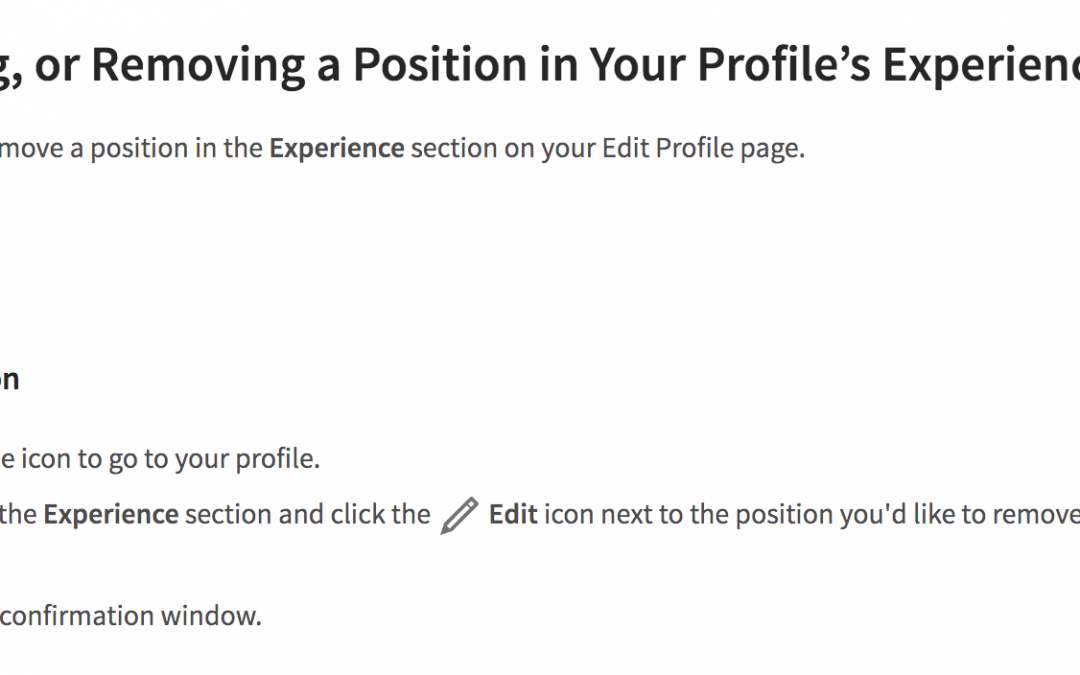
If you reach her, and she agrees, she’ll need to update her profile in the “Experience” section to reflect the end date of employment at your business. While in the “edit” mode of her profile, she should uncheck the box next to “I currently work here,” add the month and year and click “Save.”
If this doesn’t work, try removing the employee from your Company Page by submitting a request to LinkedIn Customer Service. They can perform this action for you.
1. Log into your LinkedIn Company Page.
2. Click the link to the incorrectly listed employee’s profile.
3. Note the person’s full name and the web address for her profile page to ensure this is the person you want to delete.
4. Go to the “Contact Us” Web page.
5. Type “Remove Member from Company Page” in the subject field.
6. Select “Company Pages” for the “Issue Type” field.
7. List the person’s full name, the Web address for her profile page, and an explanation for why she should be removed from your Company Page in the “Your Question” field.
8. Click “Continue” to submit your request.
At this point, you should receive a confirmation email from LinkedIn, and a ticket reference number to access the Support History Web Page. Customer Service will contact you when the person is removed, or if they require additional information.
Note: Only those with a confirmed company email address can edit information on your Company Profile. Newer company pages contain a triangular icon with a “!” character next to your company’s name on each employee’s profile page. Clicking the icon begins the “Report profile position” process that lets you report the incorrectly listed employee.
Submit a Formal Complaint.
You can also submit a formal complaint using this form on LinkedIn to report an inaccurate employment listing. This tells LinkedIn that a profile is erroneous. LinkedIn Customer Service will investigate and take action on your complaint. It may take a while for this to process, but it’s a good way to handle the situation.
How to Remove Fake LinkedIn Profiles
If you ever need to complain about a fake or inappropriate LinkedIn profile go to this page and follow the steps listed.
Lessons Learned
If you want to avoid this from happening in the future, make an addendum to the terms and conditions in your employee policy and state that each must amend all online and offline profiles to reflect that they have left your employment.
You should have some form of social media policy in place that you can provide your staff so there are no misunderstandings about what can or cannot be published online. During employees’ exit interviews, remind them to update their profiles, including LinkedIn, to reflect their last day of employment.

by Felicien | Jan 13, 2018 | Education
If you employ a person who is blind or visually impaired, you know that you must make accommodations to minimize or eliminate workplace barriers. By doing this, you not only ensure their safety but their productivity. In some instances, making these accommodations can be costly, so you must take into account the value of making them.
However, installing a digital assistant in the office won’t require a huge investment–And the return on this investment for both your blind employee and your business can be game-changing. Your best option today is the Amazon Echo.
What Is Echo?
Amazon’s Echo is a popular hands-free smart speaker that you control with your voice. When Echo is connected to the Internet, it can assist with a variety of tasks. Your visually impaired employee can use it to make calls, send and receive messages, get information from the web, make a task list, turn on and off lights, and so much more.
You can purchase Amazon’s Echo for as little as $179. The kinds of features Amazon keeps adding to Echo is mind-boggling. This is very promising for employees with disabilities.
What sets Echo apart from voice assistants like Apple’s Siri, is its responsiveness. It’s completely hands-free. There are no activation buttons to press. Your employee simply speaks a triggering word like “Alexa, “Echo,” “computer,” etc., followed by what they need to happen, and the task will complete.
Echo, it instantly provides him with the results and information he’s looking for. He won’t have to flip through pages of a book in Braille, operate an e-reader to read, or navigate a website on an electronic device. Echo will provide him the information he needs by simply asking for it.
The Basic Design of the Echo
The Amazon Echo is essentially a talking cylindrical speaker that connects to the Internet. It’s a deceptively simple looking device. It’s a black cylinder approximately 10 inches tall, 3 inches wide, with an AC power cord that you plug into a wall outlet. There are two buttons on the top of the Echo: one for power and one to turn the microphones on or off. The top of the Echo rotates either right or left to adjust the volume. The speaker inside the Echo projects throughout a medium-sized room and has several microphones to hear a voice from any direction. You can purchase a remote control separately if needed.
Echo and Alexa
Alexa is the brain behind Echo. It’s a virtual assistant that’s built in the cloud. With time, Alexa will get smarter and understand your needs. The developers keep adding “Alexa Skills” that bring new capabilities. Of course, you need to set up everything properly beforehand and get used to the system just as you would with any digital assistant, but once you do, it’s easy.
Set Up
You must have a Wi-Fi Internet connection to use the Echo, along with access to a computer, smartphone or tablet. Setup requires connecting to the Amazon website to synchronize the Wi-Fi settings in the Echo to enable the various settings, profiles, and “Skills.”
The setup can be completed by following the voice prompts from the Echo after plugging it in and downloading the Alexa app from Amazon.com. Although the initial setup requires using a computer or mobile device, once the setup is complete, the Echo can then be controlled only by voice commands. (You will need to use a computer if you want to add a new feature to your Echo.)
After setup, simply say the wake-up word, “Alexa.” Responses from Alexa are very fast. Her voice is pleasant, and one of the most human-sounding of all the digital assistants available.
Your visually impaired employee can use the Echo to:
Look up events and appointments on his calendar and find out what his schedule looks like. (“Alexa, what appointments are scheduled today?”)
Find addresses and phone numbers of clients, vendors, and coworkers. (“Alexa, what’s the address for IBM Research in Austin, Texas?”)
Set an alert. (Alexa, set an alarm in one hour to remind me about my conference call with ABC Contracting and Mary White in Accounting.”)
Make a conference call. (“Alexa, set up a conference call between ABC Contracting and Mary White in Accounting.”)
Listen to a webinar. (“Alexa, turn on the webinar I signed up for today.”)
Listen to a podcast. (“Alexa, open Cool Blind Tech from Tunein.”)
Pair a Bluetooth device. (“Alexa, pair my Bluetooth.”)
The options are endless!
Audible and Kindle
By using the Alexa app, the Echo can be synchronized to your employee’s Audible.com audiobook library, or his Kindle. For example, when the employee says, “Alexa, play “Negotiate to Win, by Jim Thomas,” the Echo will begin playing the content of the audiobook. To increase the volume, the employee can say, “Alexa, turn up the volume.”
Alexa Works with Google and Microsoft Office 365 Calendars.
One of the recent features is the integration of the “Quick Events Skill” with the Google Calendar. This lets your employee add a calendar event completely by voice. Quick Events is enabled in the Alexa App, and a Google Calendar that’s set up on his profile calendar. This only needs to be performed once from the Alexa app to get the feature started.
Once enabled, Alexa will record a calendar event by voice, using the command, “Alexa, open Quick Events.” Then, your employee simply listens and responds to Alexa’s prompts to add the calendar event. Once complete, the employee can review events in the calendar by asking, “Alexa, what’s on my calendar tomorrow?”
Amazon recently announced that its connected speakers and other Alexa-powered devices will work with Office 365 calendars. Through this integration, your blind or visually impaired employees can use voice commands to control their O365 work calendars, adding meetings and seeking information about upcoming appointments.
Echo and Alexa Can Control Appliance Switches.
The Echo can be configured to work with some appliance switches, such as the Belkin WeMo smart switches or the Phillips Hue smart luminaries. Once configured, your visually impaired employee can turn on and off certain appliances in the office using a voice command, “Alexa, turn off the fan,” or “Alexa, turn on the office light.” This feature would require the additional purchase of appliance switches to work with the Echo.
Conference Calling
Your employee can use Alexa to connect to meetings by controlling existing video conferencing equipment or by using the Echo device as a speakerphone. If there’s no scheduled meeting, Alexa prompts your employee for the meeting ID and optionally the PIN to join the meeting, and makes a PSTN call to your conferencing provider.
Amazon is Working to Make Echo a Key Component in The Workplace.
The company is hoping to make Alexa a virtual office assistant. They’re testing ways where Alexa can be used to automate daily work tasks into a few voice commands. For instance, to collaborate with Salesforce and FinancialForce, which would make it easy for a visually impaired user to interact with complex business software using voice commands. A great deal of content from the Internet is available by enabling the various Alexa Skills Amazon’s developers are quickly churning out.
As we said, the opportunities are endless for both the visually impaired and your sighted employees!